The Beat Was Not Enough
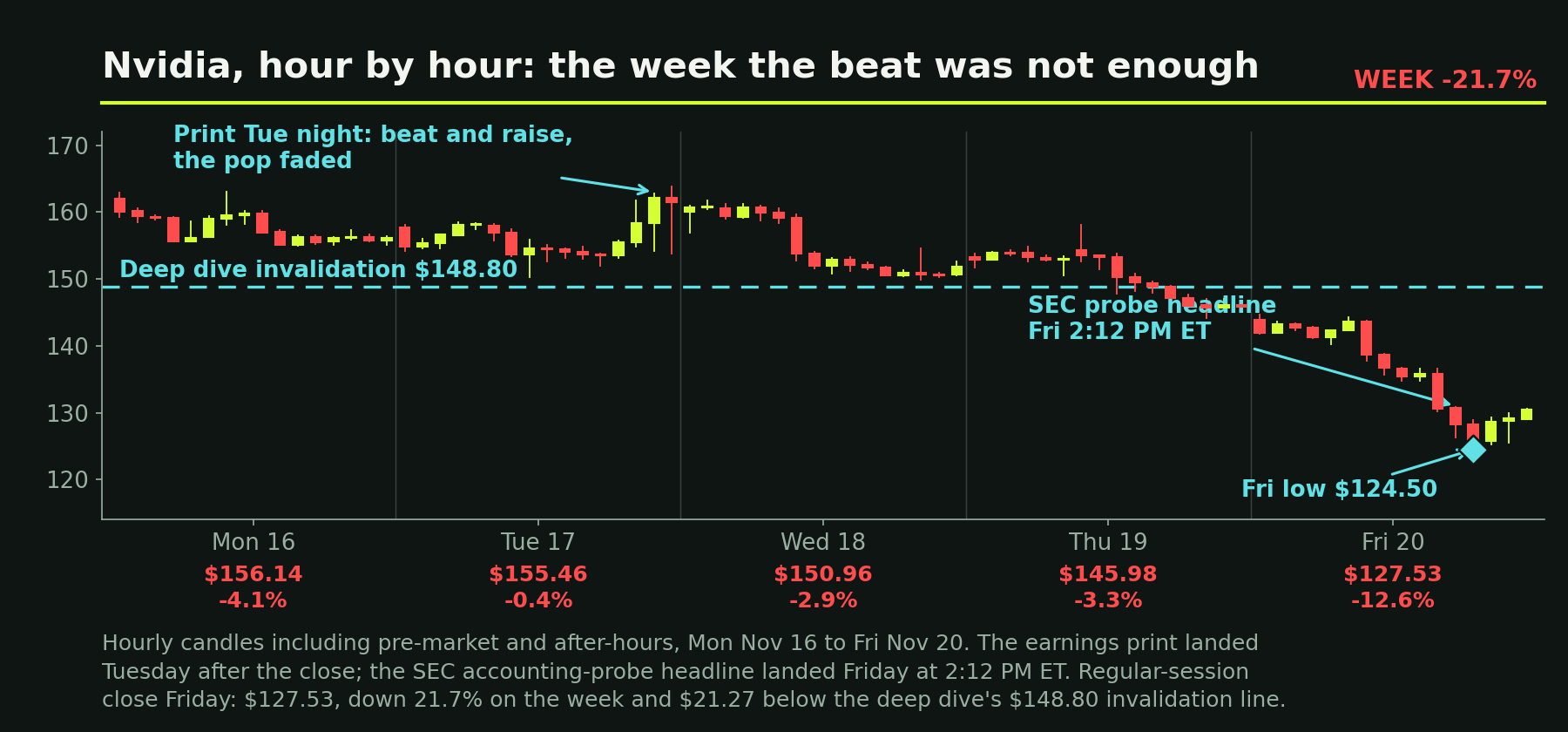
Nvidia hourly candles including extended hours, Nov 16 to 20. Friday's weekly close is the verdict against the published line.
On Tuesday night, Colette Kress did the job she was handed five days after her boss resigned.
Nvidia reported revenue of $115.8 billion, up 103% from a year earlier and $7.8 billion above the midpoint of the company's own guide. Data Center revenue was $107.6 billion, up 110%. Earnings were $2.68 a share against about $2.47 expected. The fourth quarter was guided to $130 billion. The growth outlook for next year was raised, from about 70% to about 75%. On the call, the board's chair said plainly that the board does not intend to bring Jensen Huang back.
The stock fell every day that followed. It fell on Wednesday. It fell on Thursday, through the $150 level where the biggest pile of put options sat. And on Friday it fell 12.64% more, the deepest single-day loss on this desk's board, closing at $127.53 on about 610 million shares.
That close matters for a specific reason. This desk's Nvidia deep dive, published this week, drew its line at $148.80: a sustained weekly close below that level would prove the staged buying setup wrong. Friday's weekly close is $127.53, which is $21.27 below the line. On the dive's own published terms, the setup is invalidated. We print that first in the Published Lines section below, in the same words we would use for a pass.
Nvidia was not alone. The S&P 500 fell all five sessions and seven in a row, its worst week of this slide. Anthropic priced the largest debut in market history on Wednesday night and opened 34% above its price on Thursday, and the index still reversed and closed down more than 2%. On Friday, even a consumer survey that finally showed inflation expectations cooling could not slow the selling. The VIX, Wall Street's fear gauge, closed at 39.53.
One rule runs through this issue, the same one as last week. What is filed is fact. What officials announce is on the record. What news outlets report is reporting, and we label it every time.
The scoreboard comes first.
The Scoreboard: Five Down Days
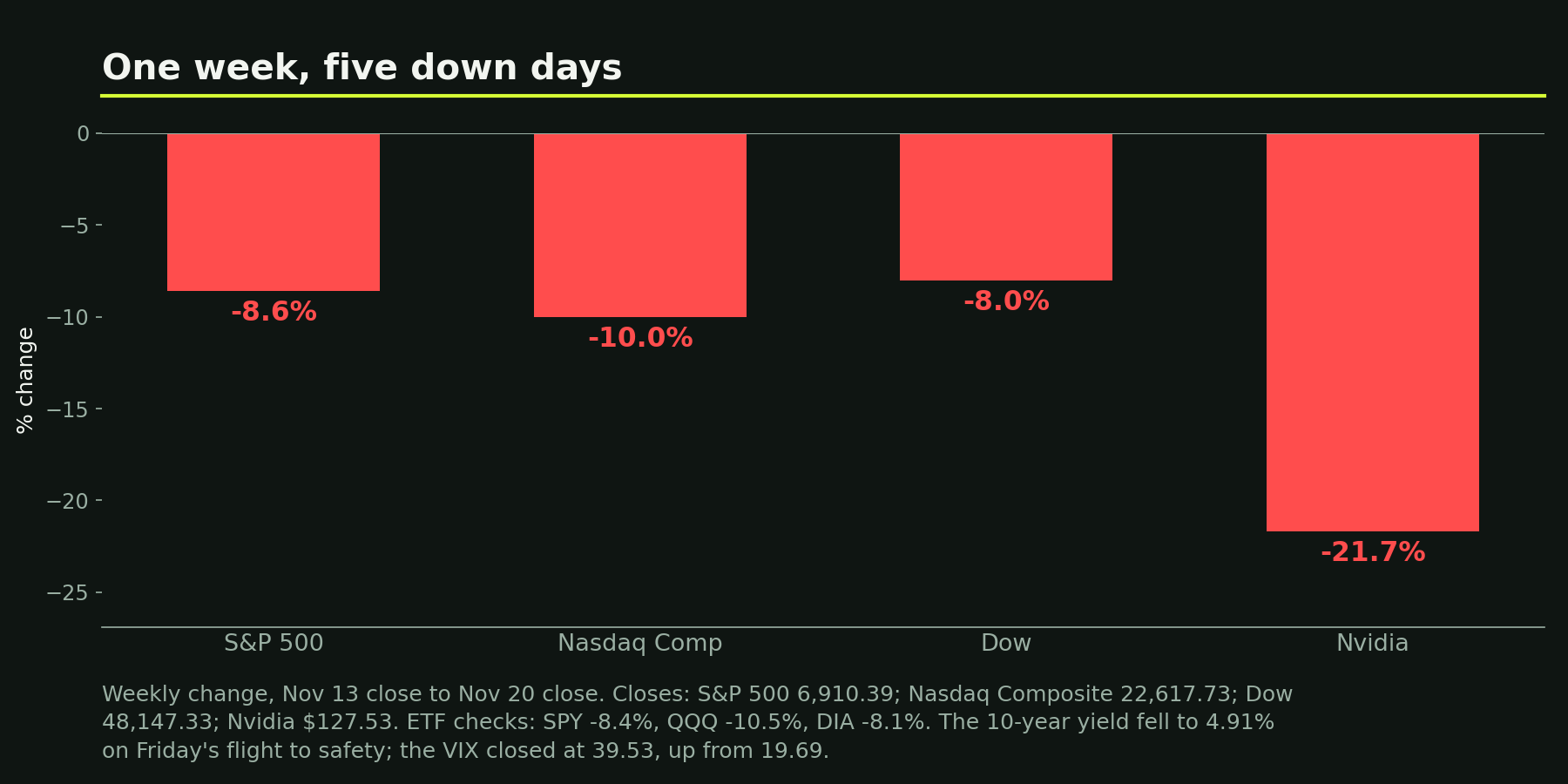
Weekly change, Nov 13 close to Nov 20 close.
S&P 500: 6,910.39. Down 8.6% on the week, with losses all five days: Monday down 1.92%, Tuesday down 1.03%, Wednesday down 0.23%, Thursday down 2.02%, Friday down 3.70%. Seven straight down sessions going back to last Thursday. (SPY: 690.87, down 8.4% on the week.)
Nasdaq Composite: 22,617.73. Down 10.0% on the week. (QQQ: 608.45, down 10.5%.)
Dow: 48,147.33. Down 8.0%. (DIA: 480.86, down 8.1%.)
10-year Treasury yield: 4.91%, down from 5.15% a week earlier. The yield fell on Friday because buyers ran to safety, not because the Fed turned friendly. Wednesday's minutes, covered below, point the other way.
VIX: 39.53, up from 19.69 a week earlier. It more than doubled in five sessions and traded above 40 during Friday's session.
U.S. crude (WTI): $83.86 a barrel, down from $88.99.
Read the first and fourth lines together. Stocks had their worst week of this slide while the fear gauge doubled. Last week, fear lived in one stock. This week it moved back into the whole index, and then some.
The S&P 500 closed more than 8% below both its 20-day and its 50-day average prices. In plain terms: the index is not near a level where it has recently found buyers. It is falling through open space, which is why each day's low became the level that mattered.
Nvidia: The Print Was Real
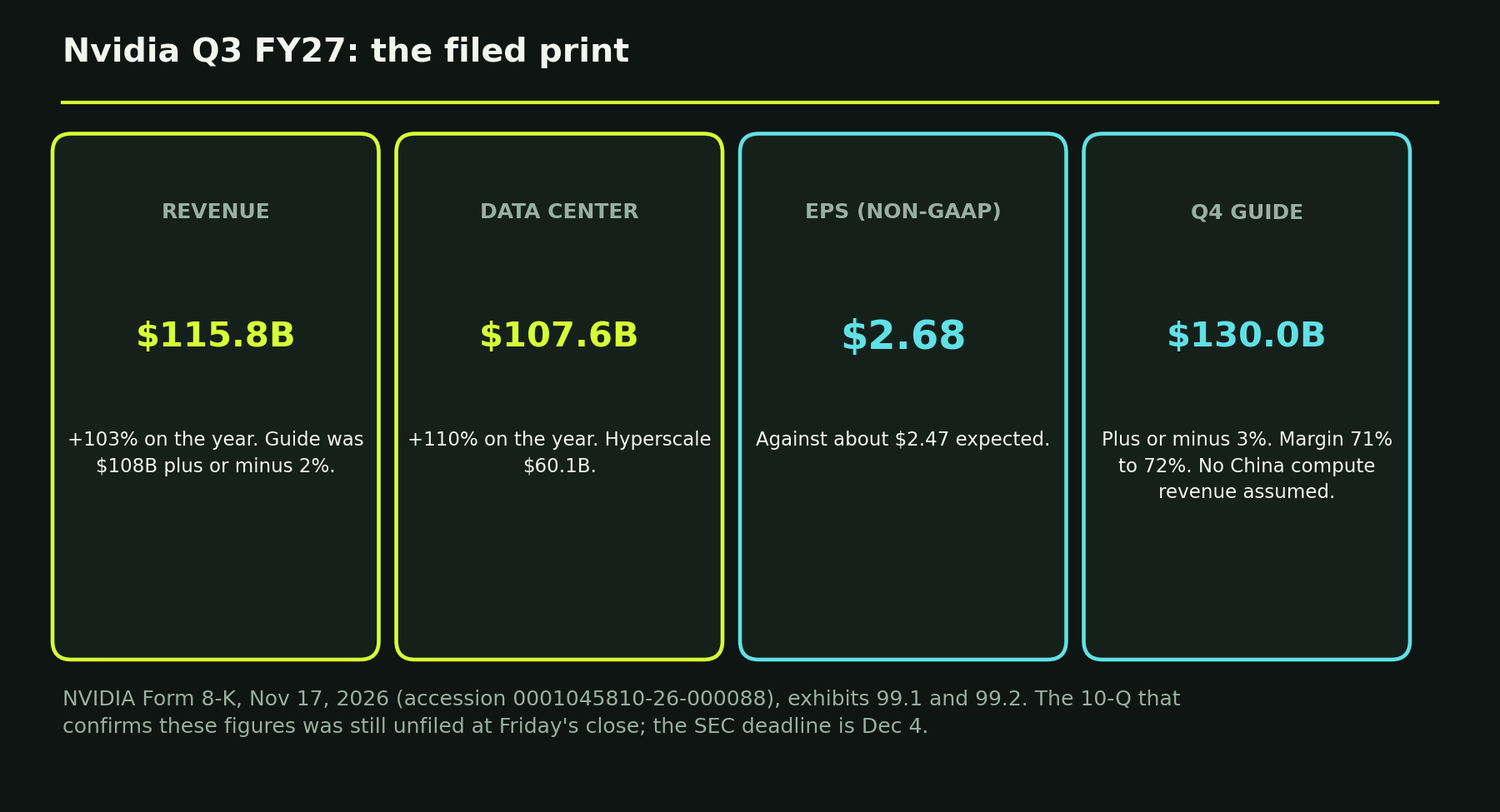
NVIDIA Form 8-K, Nov 17, 2026. The 10-Q confirmation is still outstanding.
Start with what the company filed, because the filed numbers are strong by any measure.
Revenue of $115.8 billion rose 103% from a year earlier. The company's own guide for the quarter was $108 billion, plus or minus 2%. The result beat the top of that range by $5.6 billion. Data Center revenue was $107.6 billion, up 110%, with $60.1 billion from the big cloud builders and $47.5 billion from AI clouds, industrial and enterprise customers. Earnings were $2.68 a share on the adjusted measure Wall Street watches, against about $2.47 expected.
Guidance, exactly as given on the release and repeated on the call: fourth-quarter revenue of $130.0 billion, plus or minus 3%, in a quarter with one extra week. Gross margin of 71% to 72%, which Kress called the bottom, with a recovery to 72% to 73% expected next year. No Data Center compute revenue from China is assumed in the guide.
The outlook that moved: the company raised its growth view for next year to about 75%, up from about 70% given in August, and said demand still runs ahead of supply even after new export controls were assessed.
Call color, labeled as call statements: Vera Rubin, the new flagship system, produced nearly $20 billion of revenue in its first production quarter. Networking revenue passed $21 billion. The industry's order backlog stands at $2.5 trillion. Shipments of licensed Hopper chips to China were $2.4 billion in the quarter, and the company says it is no longer shipping licensed Hopper data center products to China.
Now the other half of the filing, the half the market traded. Supply commitments rose from $279 billion to $390 billion in one quarter. Total future commitments are $518 billion. Accounts receivable, money customers owe the company, reached $81 billion, equal to 64 days of sales, up from 60 days, on longer payment terms for some large customers. And the company carries up to $118 billion of guarantee exposure, most of it credit support behind a data center campus in Ohio leased to OpenAI. On the call, Kress clarified the guarantees: they only take effect after the other side has raised its own money and finished building, and if the building never happens, the guarantee does not exist. That clarification matters, and it is in the company's own words.
One checkpoint stays open. The quarterly report, the 10-Q, has still not been filed. The company said on the release and again on the call that it will file "in the coming weeks." The SEC deadline is December 4. We checked EDGAR again while building this issue on Friday afternoon: the newest filings are a Form 144 dated November 19 and Tuesday's earnings 8-K. There is no 10-Q. Nothing is late under the rules. It is still the document that has to confirm everything above, and until it lands, every figure in this section is release-grade, not filing-grade.
So why did the stock fall 21.7% in the week it beat and raised? Because the market was not grading the quarter. It was grading trust: a founder gone, an investigation open, a filing delayed past its usual date, and a balance sheet that now finances and guarantees a growing share of the buildout it sells into. Strong numbers answered the demand question. They did not answer the other ones. Friday's close says the market wants the filing, not another good quarter.
Filed, Announced, and Reported
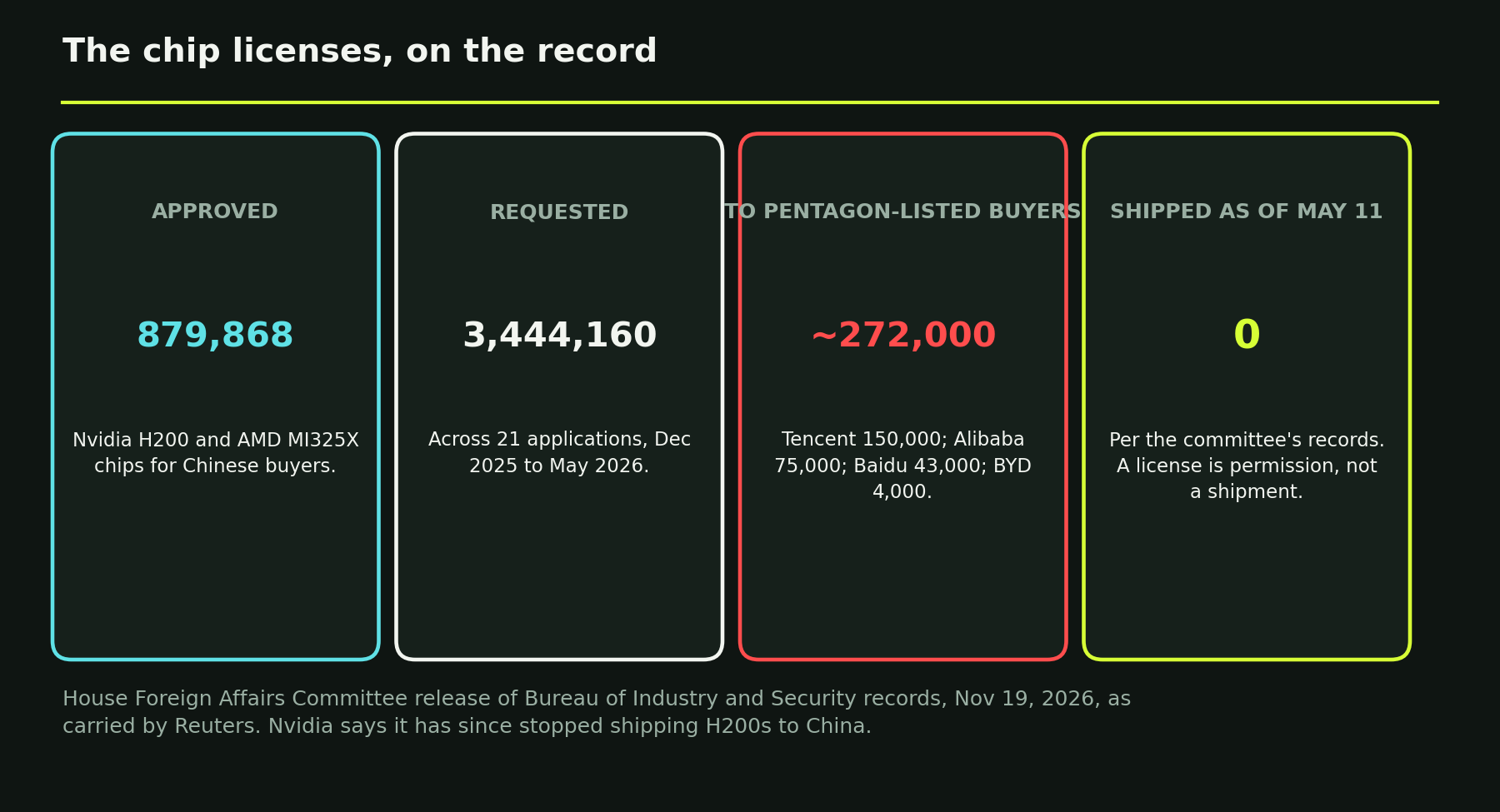
House Foreign Affairs Committee release, Nov 19, 2026, as carried by Reuters.
Three separate boxes. Keep them separate.
WHAT IS FILED. The earnings release and CFO commentary of November 17, filed as exhibits to an 8-K: the results, the $130 billion guide, the $390 billion of supply commitments, the $518 billion total, the $118 billion maximum guarantee exposure, and the plan to file the 10-Q in the coming weeks. Also filed: the November 12 resignation 8-K covered in Issue #006.
WHAT IS ON THE RECORD. On Thursday, November 19, the House Foreign Affairs Committee released Commerce Department licensing records it obtained under the Export Control Reform Act. The records show the Bureau of Industry and Security approved 879,868 Nvidia H200 and AMD MI325X chips for Chinese buyers between December 2025 and May 2026, out of 3,444,160 requested across 21 applications. About 272,000 of the approvals went to four buyers on the Pentagon's list of Chinese military companies: Tencent 150,000, Alibaba 75,000, Baidu 43,000, and BYD 4,000. Two cautions belong with this, and the committee's own records support both. A license is permission, not a shipment: the records show that as of May 11, none of the approved chips had shipped. And Nvidia says it has since stopped shipping H200s to China. The same day, California Attorney General Rob Bonta announced his office had served Nvidia an investigative subpoena, looking at whether chips or confidential information reached China and whether the company misled investors and the public. A subpoena is the start of an inquiry. It is not a finding, and no finding has been made.
WHAT IS REPORTED. The Wall Street Journal has reported that the SEC is investigating Nvidia's disclosures. The SEC has not confirmed that publicly, so it stays in this box. The December hearing and interview schedule for Huang is also reporting, covered in the Week Ahead section with its label on.
Our read, separate from all three boxes: none of this week's official paper changes what Nvidia sells or what it earned. All of it changes how much proof the market demands before it believes the next set of numbers. That is why the unfiled 10-Q, a routine document in any normal quarter, is now the most important piece of paper in the AI trade.
The Debut That Could Not Lift the Market
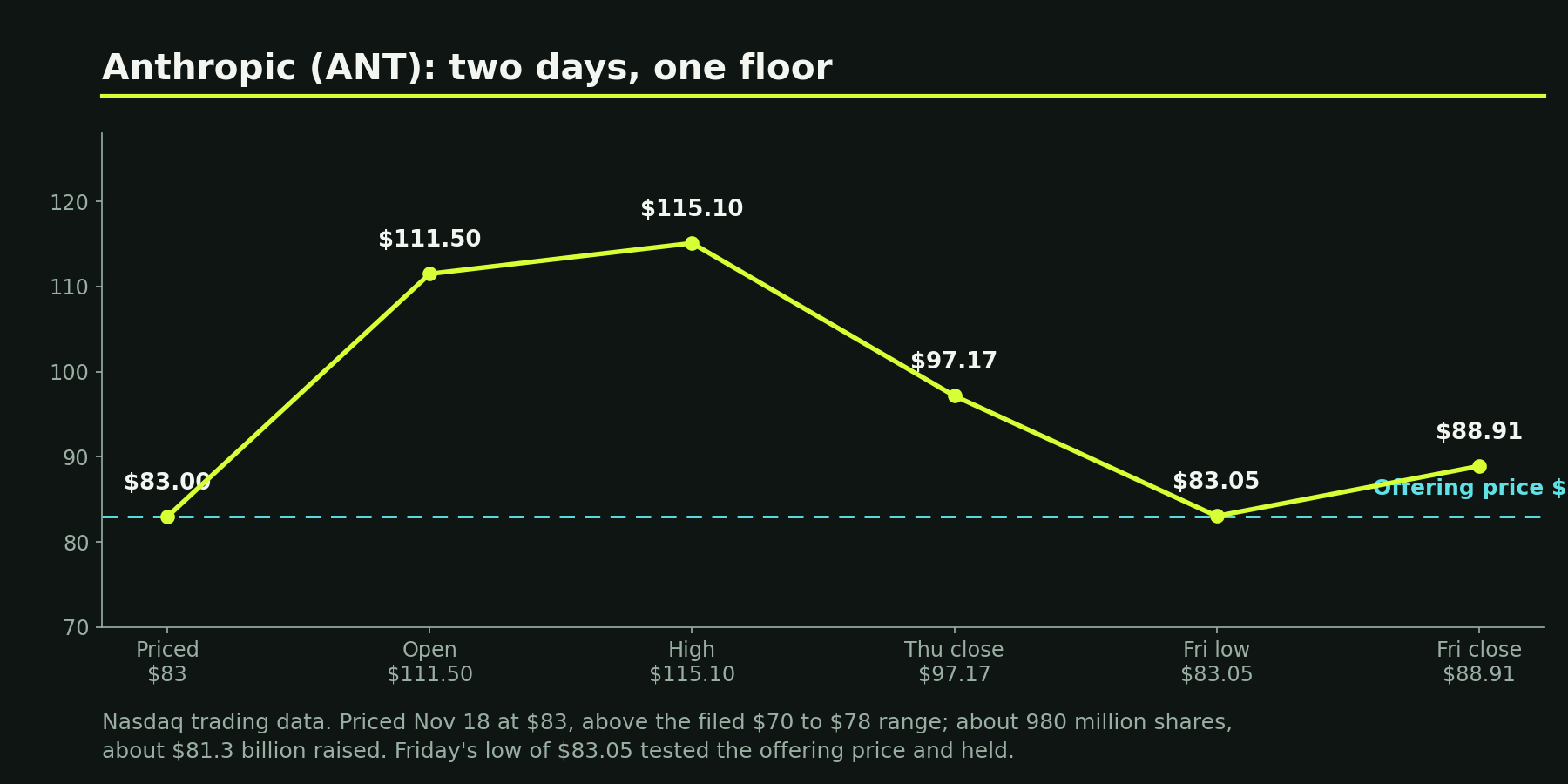
Nasdaq trading data, Nov 19 to 20, 2026.
On Wednesday night, Anthropic priced its first public shares at $83, above the $70 to $78 range it had filed. The sale covered about 980 million shares and raised about $81.3 billion, the largest debut on record by money raised.
Thursday's first trades told two stories in one day. The stock opened at $111.50, up 34% from the price. It ran to $115.10. Then it faded all afternoon while the index reversed, and closed at $97.17, up 17.1% on the day, on 857 million shares. A debut that opens at $111.50 and closes at $97.17 made money for the people who got shares at $83 and cost money for the people who chased the open. Both facts are in the same candle.
Friday was the second day, and it was a test of the $83 price itself. The stock fell 8.50% to close at $88.91. Its low was $83.05, five cents above the price the underwriters set. Buyers showed up at the offering price on the worst day of the week. That is the single most useful fact about the debut: on a day when the S&P 500 fell 3.70%, the newest and most speculative name in the market held its issue price.
What the debut did not do is lift anything else. The money for an $81 billion offering comes from somewhere, and this week it visibly came out of the rest of the AI complex. Nvidia fell 21.7% in the same five days. The first public price on a frontier AI lab is now set, and it is $88.91, about 7% above where the bankers priced it. The market's verdict on AI did not change because one lab listed. It just got a second ticker to express itself through.
One more debut-week item, smaller but instructive. SanDisk, the memory maker, completed an 8-for-1 stock split after Thursday's close, announced in an October filing. Thursday's $755.16 close became a $94.40 reference price on Friday morning. Nothing about any holding changed: each share became eight shares at one-eighth of the price. The stock then fell for real, closing at $79.24, down 16.1% on a split-adjusted basis. If your screen showed SanDisk down 89% on Friday morning, that was the split, not a crash. The crash, 16%, came after.
The Hawkish Repricing
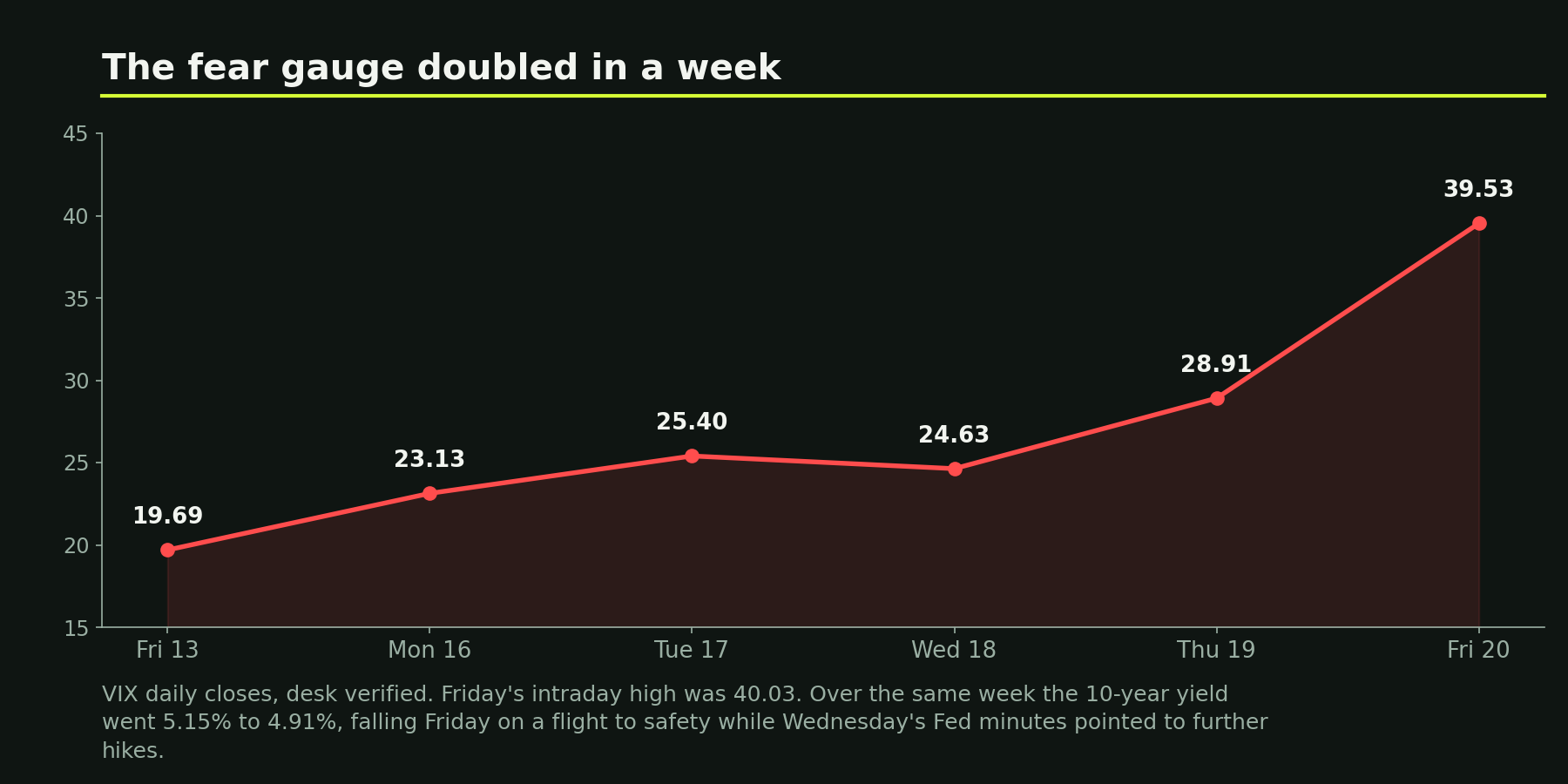
VIX daily closes, desk verified.
Underneath the Nvidia story, the week's second engine was the Federal Reserve moving the other way from what stock investors wanted.
On Wednesday at 2 PM, the Fed published the minutes of its October 27 to 28 meeting. The vote at that meeting was 10 to 2 to hold rates at 3.75% to 4.00%. The two dissents, Governor Lisa Cook and Cleveland Fed President Beth Hammack, wanted a quarter-point hike at that meeting. The minutes show almost all officials judged that further rate increases would likely be appropriate. A couple of them said a move larger than a quarter point could deserve consideration in December if inflation data came in unfavorably. Since that meeting, the inflation data has come in unfavorably: October core prices rose 0.3% for a third straight month. Governor Christopher Waller made the case publicly on Wednesday for a half-point December hike, or a much stronger signal that more tightening is coming. Futures markets now price a December hike as close to certain, with the open question being its size.
Thursday showed what that pricing does to a stretched market. The morning opened green, with Nvidia up 3.75% at mid-morning on the Anthropic debut. By the close, the S&P 500 was down 2.02%, the Nasdaq Composite down 2.25%, the Dow down 2.19%, and the VIX up to 28.91. Dealer positioning made it worse: the options dealers who hedge the index ended Thursday far shorter than they started it, which means their hedging sold into the decline instead of cushioning it. Every core name on this desk's board except one small fund closed red.
Friday brought the week's one softening data point, and it changed nothing. The University of Michigan's final November sentiment reading came in at 51.5, up from 48.0 in October. More important for the Fed debate, consumers' expected inflation for the year ahead fell to 3.7% from 4.7%, and the five-year view eased to 3.3%. Those are survey expectations, not measured prices, and we label them that way. The market's answer was to fall 3.70% anyway, with the VIX closing at 39.53. When good news cannot lift a market, the market is telling you the problem is positioning and liquidity, not data.
Put the week together: the central bank is debating how much to raise rates, the largest company in the index is trading on trust instead of numbers, and the biggest debut in history absorbed cash instead of creating confidence. Each of those is survivable alone. Together, they produced five straight down days and a fear gauge at 40.
What the Flow Said
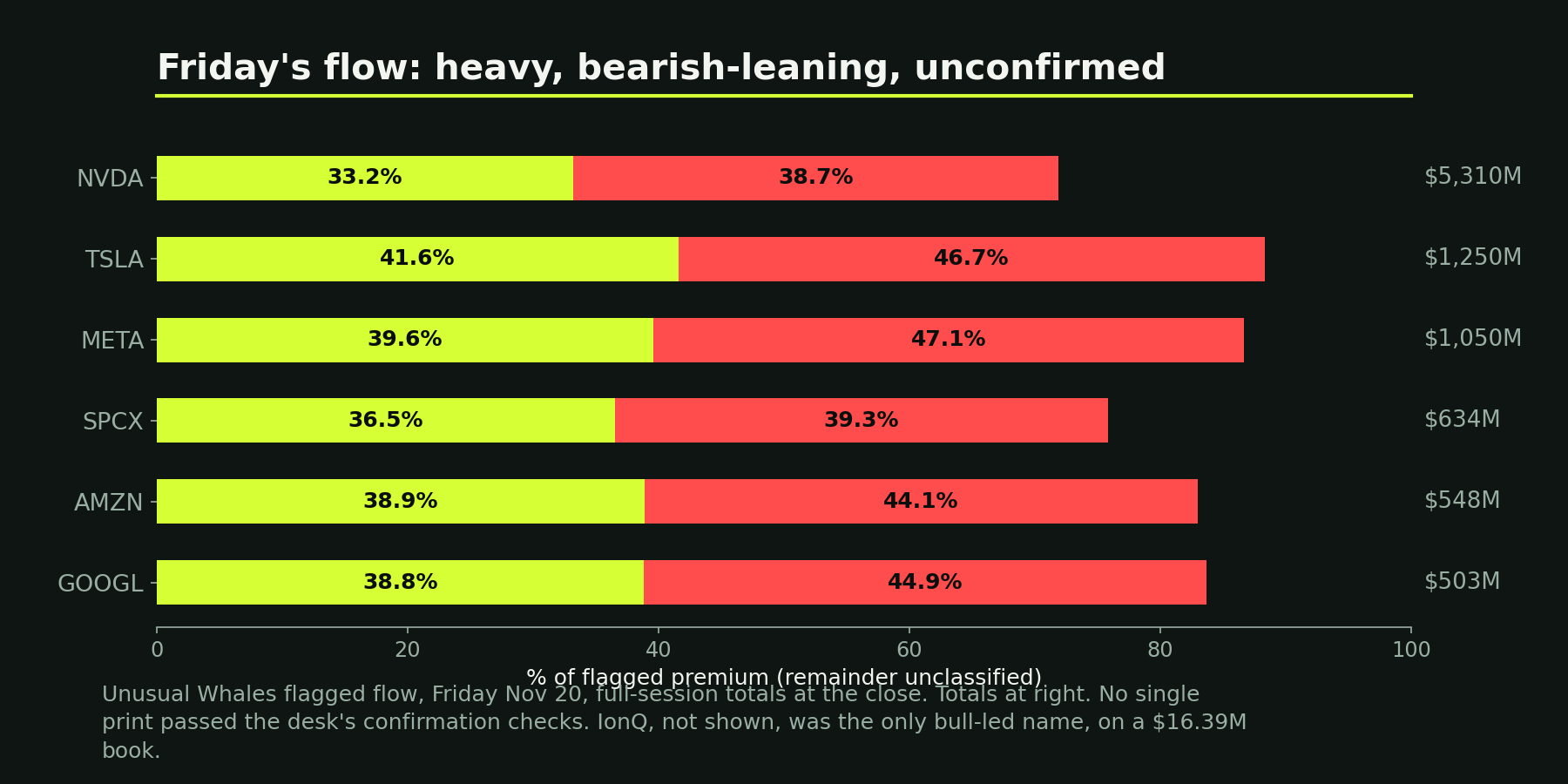
Unusual Whales flagged flow, Friday Nov 20, full-session totals at the close.
Friday's options tape was heavy and leaned one way, without producing a single clean signal.
Nvidia drew about $5.3 billion of flagged premium on the full day, with about $2.05 billion bearish against about $1.76 billion bullish. The largest prints were not simple bets: the top of the tape was January 2029 call sales from the morning, and the biggest late prints were a multi-leg put structure at $210 to $220 strikes into next week's expiry, printed on the floor in the last hour. The shapes of investors reducing or restructuring positions, not opening new ones.
Tesla drew about $1.25 billion, bearish dollars ahead about $583 million to $518 million. Meta drew about $1.05 billion, $493 million bearish to $415 million bullish, with its biggest prints a multi-leg call structure rather than an outright bet. SpaceX drew about $634 million, close to balanced, with one notable shape: sales of January 2027 put options at strikes from $120 to $140, printed through the afternoon into the close. Selling a put is a willingness to own the stock lower. It was the only expression of that willingness on Friday's tape. SpaceX's two largest prints, late floor trades in December $195 and $200 puts, carried no directional tag at all.
IonQ was the only name where bullish dollars led, about $7.4 million to $6.5 million, on a book of about $16 million that is too small to carry a conclusion.
No single large trade passed the desk's confirmation checks on Friday. On this desk, an unconfirmed print is not a signal, however big it looks.
One honest gap. The desk's gamma map, the dealer positioning picture we print every week, could not be read on Friday: the data source returned errors all day, in every snapshot. So this issue prints no gamma walls for Friday, and it does not carry Thursday's walls forward, because Friday's move ran through them. The desk's regime label printed UNKNOWN on Friday for the same reason: a data outage, not a market call. The verified tape underneath it needs no label. The index is more than 8% below both of its key averages, the fear gauge closed at 39.53, and the board closed all-red two straight sessions. Treat the posture as risk-off in practice until a level actually holds.
The Published Lines: Friday's Closes
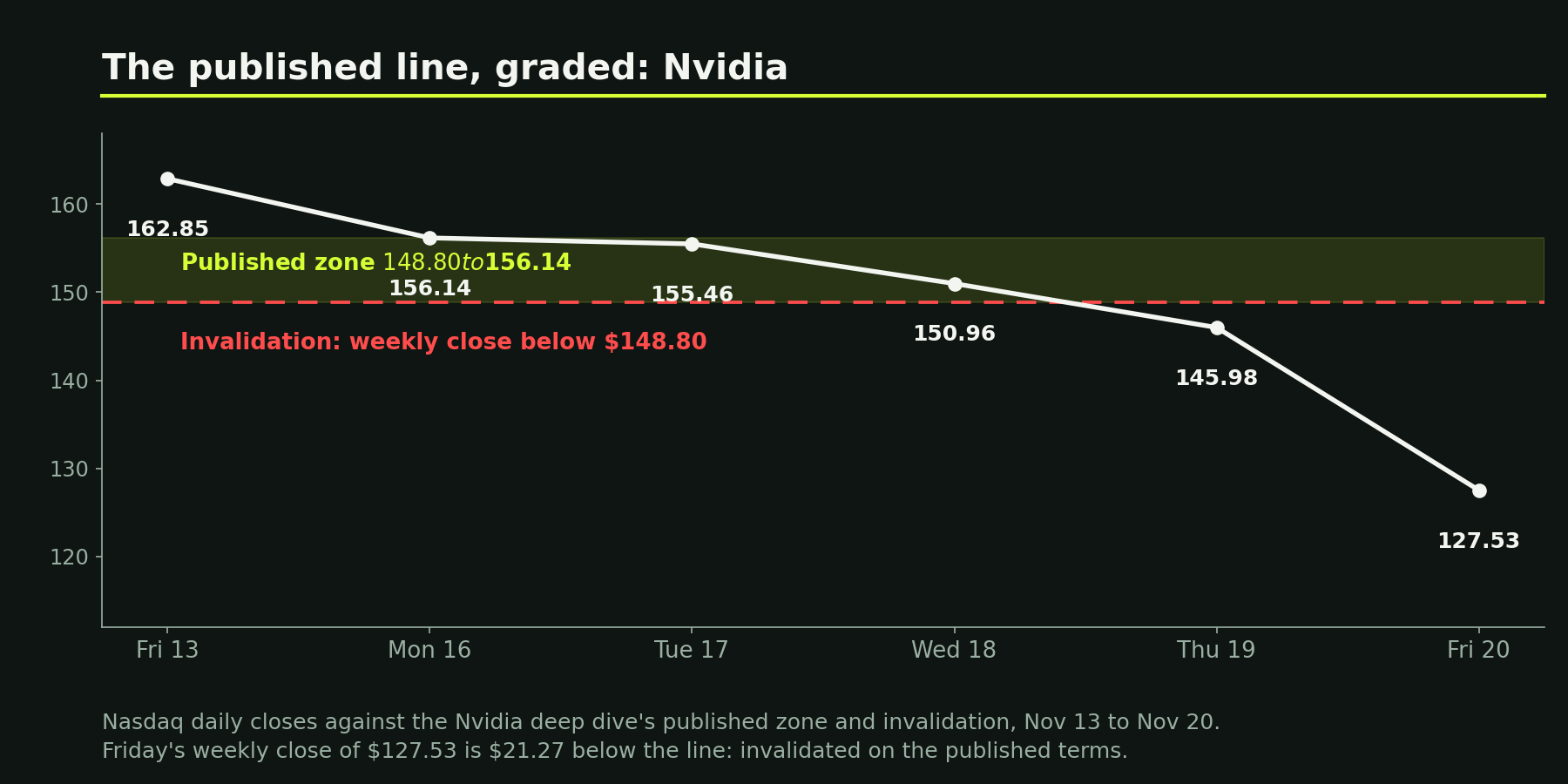
Nasdaq daily closes against the published zone and invalidation.
A line is only worth something if you report it the same way when it fails. This week, four failed. They come first. All four failed in a week the S&P 500 fell 8.6% and the Nasdaq fell 10.0%. That is context, not an excuse. Each line below says why the name failed and what would put it back in play.
Two terms run this section. A staged entry means buying in planned pieces inside a zone. An invalidation is the line that proves the setup wrong, judged on the weekly close, exactly as published.
Nvidia: the deep dive published this week carried a staged BUY at $148.80 to $156.14, with invalidation on a sustained weekly close below $148.80. Friday's weekly close is $127.53, which is $21.27 below the line. That is an invalidation on the published terms, in the first week after publication. The second tranche, which required a weekly close back above $166 to $174, never came into play. The remaining reserve was held for the 10-Q or a deeper flush. The 10-Q is still unfiled, and the flush arrived without it. Why it failed: a reported SEC accounting probe, the one headline no price setup can see coming, landed on a stock already sliding from its print. What we are watching: the 10-Q filing and the probe's scope. The setup exists again only on a weekly close back above $148.80.
Palantir: published setup BUY, staged $155 to $168, invalidation on a weekly close below $150. Closed $143.49. Below the line. Invalidated. Why it failed: no company headline did this. It fell 14.6% in a week when the market liquidated high-multiple names together, straight through the zone. What we are watching: a weekly close back above $150. Below it, there is no setup.
Alphabet: published setup BUY, staged $270 to $295, invalidation on a weekly close below $267.47. Closed $265.29. Below the line by $2.18. Invalidated. Why it failed: the shallowest failure on the board, $2.18 through the line. No company news broke the thesis; the flush did. What we are watching: $267.47. One weekly close back above it restores the line, and it is the closest watch we have.
Cummins, the WATCH line: staged $429 to $456, invalidation on a weekly close below $428.74. Closed $403.84. Below the line. The WATCH is invalidated. The older Cummins gate at $497 to $516 was never reached and stays unreached. Why it failed: it fell 10.7% with the industrial complex in the same flush, and the setup never got near its entry conditions. What we are watching: a weekly close back above $428.74. Until then, the WATCH stays off.
IonQ: the $30 line failed last week at $28.86 and fell further this week, closing at $20.76. Still below, still failed, printed the same way. The gap widened: down 28.1% this week, the worst on the board. What we are watching: nothing re-opens below a weekly close at $28.18.
Rigetti: the $11.11 line failed last week at $9.62 and fell further, closing at $7.15. Still below. What we are watching: $11.11 on a weekly close. Until then it stays a failed line, printed the same way.
Now the rest of the board.
AMD: published setup BUY, staged $440 to $466, invalidation on a weekly close below $413. Closed $424.39, down 20.5% on the week. The stock fell through the zone and closed $11.39 above the invalidation. The zone is now overhead, and the line at $413 is the one that matters. What we are watching: next Friday's close against $413. That line, not the zone above, decides this one now.
Microsoft: published setup BUY, staged $500 to $520, invalidation on a weekly close below $480. Closed $484.52, which is $4.52 above the line. Intact, with almost no room left. What we are watching: $480. It has $4.52 of room and no more.
Apple: published setup BUY, staged $320 to $334, invalidation on a weekly close below $309. Closed $342.56, above the zone. The invalidation is untouched.
Amazon: published setup BUY, staged $215 to $232, invalidation on a weekly close below $198.79. Closed $246.82, above the zone. Intact.
All of the desk's deep dives are in the research library at zerogammaresearch.com/library, with the full work behind every zone and invalidation above.
Rapid Fire
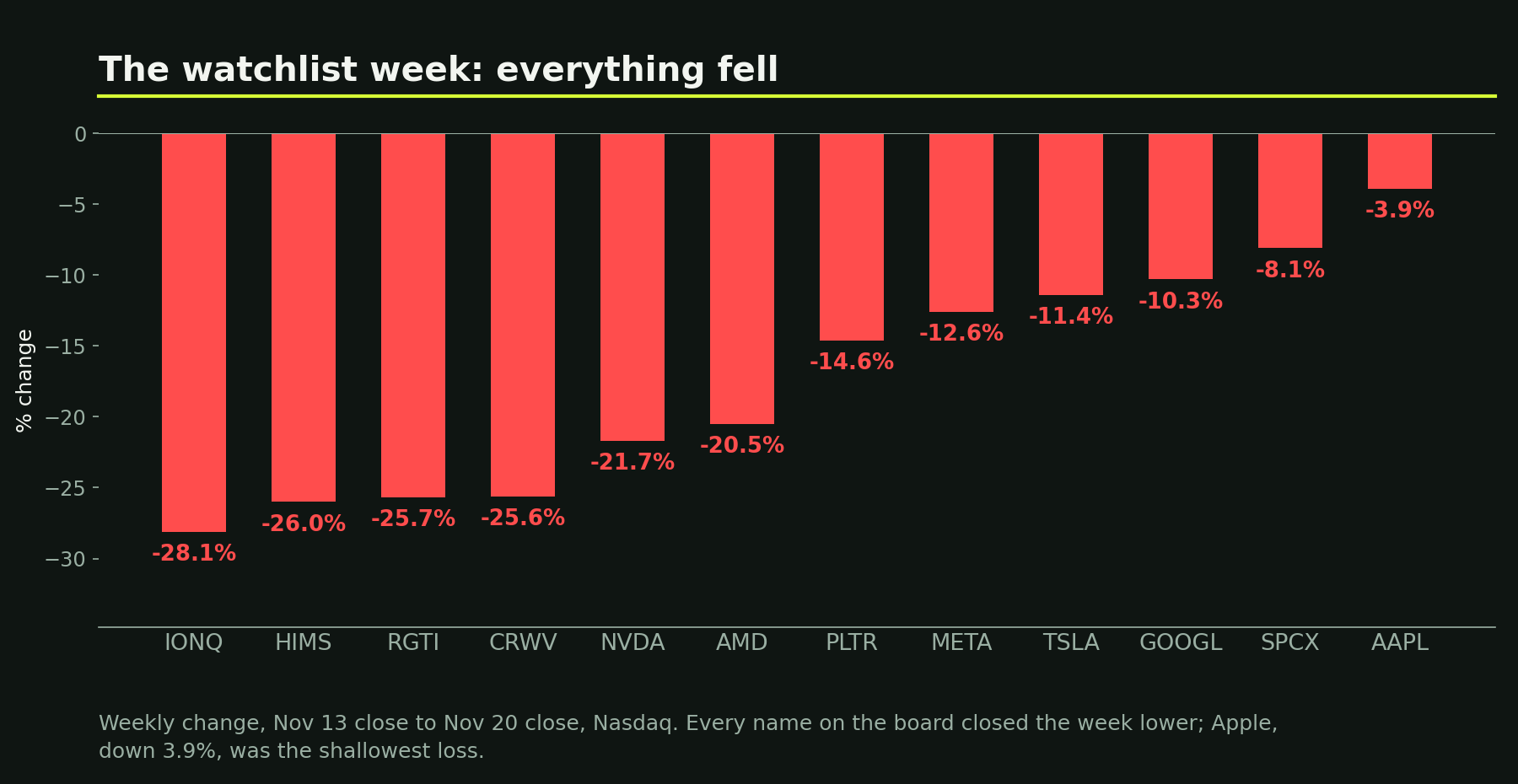
Weekly change, Nov 13 close to Nov 20 close, Nasdaq.
Nvidia fell 21.7% on the week to $127.53, including a 12.64% drop on Friday on about 610 million shares.
IonQ fell 28.1% to $20.76, the watchlist's worst week.
Hims & Hers fell 26.0% to $14.61, Rigetti fell 25.7% to $7.15, and CoreWeave fell 25.6% to $39.51.
AMD fell 20.5% to $424.39 and Broadcom fell 12.3% to $304.41, as the chip complex sold off together.
Palantir fell 14.6% to $143.49, through its published invalidation.
Meta fell 12.6% to $560.84.
Tesla fell 11.4% to $345.82. Cummins fell 10.7% to $403.84. Alphabet fell 10.3% to $265.29.
SpaceX fell 8.1% to $127.79. Microsoft fell 7.5% to $484.52. Amazon fell 7.4% to $246.82.
Apple fell 3.9% to $342.56, the shallowest loss among the mega-caps.
Anthropic closed its second day at $88.91, down 8.50% on the day and still above its $83 offering price.
SanDisk closed its first split-adjusted session at $79.24, down 16.1% from its $94.40 split reference price.
Intuit fell 12.77% on Friday to $270.44 after beating on the quarter and cutting its outlook.
Walmart rose 1.52% on Friday to $127.95, one of the session's rare gains.
The VIX rose from 19.69 to 39.53 in five sessions. The 10-year yield fell from 5.15% to 4.91% as buyers ran to safety on Friday.
Next Week: A Short Week With Long Shadows
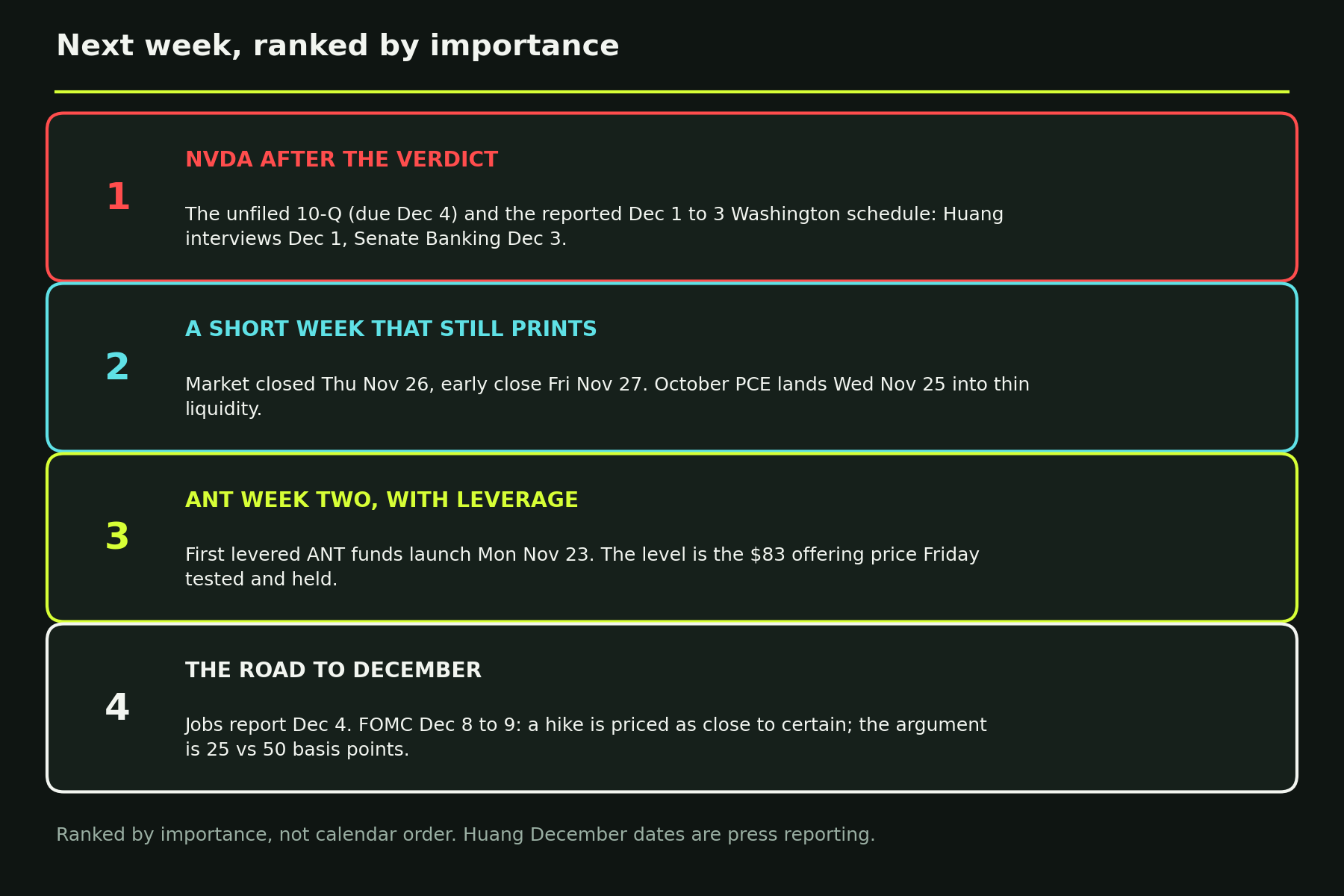
Ranked by importance and market impact, not by calendar order.
1Nvidia after the verdict. The price question is settled: $127.53 against a $148.80 line, and the line won. What remains is paper and testimony, and the calendar is crowded. The 10-Q is still unfiled, due by December 4, and it is the one document that can confirm the quarter's $115.8 billion, the $390 billion of supply commitments, and the guarantee language in the company's own filed words, or complicate all three. Around it sits a reported December schedule with no real precedent: Huang's closed-door House interviews on December 1, the general counsel on December 2, and a Senate Banking hearing on December 3 with Huang and Commerce Secretary Howard Lutnick invited. Those dates are press reporting, not filings, and only an official statement moves them out of that box. While the paper plays out, the chart keeps one marker: Friday's $124.50 low. A filing that lands clean settles the trust question one way. Continued silence settles it the other way. |
2A Thanksgiving-shortened week, and what still prints. The market is closed Thursday, November 26 for Thanksgiving and closes early on Friday, November 27, and the desks empty out from Wednesday afternoon. One major release still lands in that empty room: October PCE inflation, the Fed's preferred price measure, on Wednesday, November 25. It arrives with a live argument attached, because the Fed minutes pointed toward further hikes and Governor Waller has floated a half point for December. Short weeks trade thin, and thin markets move further on the same news. A hot PCE print into a room that thin is the week's main accident risk, in either direction. |
3Anthropic's second week, and the leverage that arrives with it. On Monday, November 23, the first levered funds tied to ANT begin trading, long and short both. Levered funds reset daily: they buy exposure into a rising close and sell into a falling one, every day, mechanically. On a stock with two sessions of trading history and no settled shareholder base, that flow is fuel in both directions, and the short funds hand Friday's sellers a leveraged instrument of their own. The level that matters is the one Friday already tested: the $83 offering price, which held by five cents at the $83.05 low. Holding it keeps the debut's story intact. Losing it on a close turns the largest debut in history into one more falling AI name. |
4The road to December 4 and December 8 to 9. December 4 is a pile-up: the jobs report lands the same day Nvidia's 10-Q is due, two of the month's biggest questions answered within hours of each other. Four days later the Fed meets, December 8 and 9, with a rate hike priced as close to certain and the argument now about size: a quarter point, or the half point Waller floated. After a week in which the index fell 8.6%, the market goes into that stretch needing the data to argue against the bigger move. Every print between now and then, starting with Wednesday's PCE, is read through that one question. |
How to Use This Issue
Three self-checks before anything in this letter touches your own portfolio: 1Grade the lines, including ours. Four published setups were invalidated this week on their own stated terms, starting with the newest and largest one. A research process that prints its failures in the same words as its passes is the only kind worth following. Check whether yours does. 2Know which box a claim sits in. Nvidia's results are filed. The chip licenses and the California subpoena are on the record. The SEC probe and the December hearing dates are reporting. The three boxes carry different weight, and mixing them is how expensive mistakes get made. 3Respect the calendar in a thin week. A holiday-shortened market, a PCE print on Wednesday, levered funds launching on a two-day-old stock on Monday, and a Fed decision three weeks out. Size for the liquidity that will actually be there, not the liquidity of a normal week. Education only, always. The setups in this letter are the desk's research calls, published with their invalidation lines so you can grade us in public. They are not personalized advice, and the decisions stay yours. |
WE’RE WATCHING
Nvidia's 10-Q. Still unfiled at Friday's close, due by December 4. It confirms the $115.8 billion quarter, the $390 billion of commitments, and the guarantee language, or it does not.
Nvidia's $124.50 Friday low. The stock closed $3.03 above it after a 12.64% day. Holding it is the first sign of stabilization. Losing it keeps the slide open.
The $83 Anthropic line. Friday's low was $83.05 and the close was $88.91. The offering price is the debut's floor until proven otherwise, and levered funds start trading against it on Monday.
The December hike's size. A quarter point is priced as close to certain. The half point Waller floated is the tail that would reprice everything again.
October PCE on Wednesday. The Fed's preferred inflation measure lands in the thinnest week of the quarter.
The VIX at 39.53. It doubled in a week and traded above 40 on Friday. Peaks in fear usually come near turning points, but "usually" is not a level. A close back under 30 would be the first hard evidence of calm returning.
The S&P 500 against its averages. The index closed more than 8% below both its 20-day and 50-day averages. Reclaiming ground starts with a single session that holds a prior day's low instead of breaking it.
Alphabet at $265.29 and Microsoft at $484.52. Two published lines sit within a few dollars of their invalidations after Friday. Their next weekly closes grade them.
SanDisk after the split. The split changed nothing but the share count. The 16% split-adjusted drop on Friday is the real signal to grade.
| The desk’s posture: patient, defensive, levels over narratives, in a tape that is risk-off in practice whatever the data feed calls it. This week the market sold a beat, a raise, a record debut, and a cooling inflation-expectations print, in that order. When everything gets sold, the correct response is not a story. It is a list of levels and the discipline to wait for one of them to hold. |
The Receipts
Here is where this week's numbers come from, so you can check us.
Nvidia's results and guidance: the company's Form 8-K of November 17, 2026, accession 0001045810-26-000088, exhibits 99.1, 99.2 and 99.3, read on the SEC's EDGAR system, including the CFO commentary's commitments and guarantees tables. Call color is from the November 17 earnings call transcript, labeled as call statements wherever used. The board's no-reinstatement statement is Chair Harvey Jones on that call.
The 10-Q status: EDGAR's filing index for Nvidia, checked again on Friday, November 20 during this build. The newest filings are the November 19 Form 144 and the November 17 8-K. The December 4 deadline is the SEC's 40-day rule for accelerated filers from the October 25 quarter end.
Market closes: Nasdaq closing data. Friday closes from Nasdaq's official close feed, cross-checked against the desk's verified close briefs for November 16 to 20; the daily series through Thursday from Nasdaq historical data. Index closes from the daily candle series the desk verifies each session. Treasury yields, oil, and the VIX from the same verified close briefs.
Anthropic: the final pricing as reported at pricing on November 18 and carried in the desk's morning brief of November 19; Thursday and Friday trading data from Nasdaq, including the $83.05 Friday low and the $88.91 close.
The chip licenses: the House Foreign Affairs Committee's November 19 release of Bureau of Industry and Security records, as carried by Reuters and other outlets, with the committee's own figures: 879,868 approved of 3,444,160 requested, and no shipments recorded as of May 11. The California subpoena: Attorney General Bonta's November 19 statement from his office. The SEC probe: The Wall Street Journal, labeled as reporting.
The Fed: the Federal Reserve's minutes of the October 27 to 28 meeting, released November 18. Governor Waller's remarks as reported by CNBC the same day. December pricing: CME FedWatch as reported.
Michigan sentiment: the University of Michigan Surveys of Consumers final November release, November 20: index 51.5, year-ahead inflation expectations 3.7%, five-year 3.3%.
SanDisk: the company's October 29 split announcement and 8-K, 8-for-1, effective after Thursday's close; Friday's close from Nasdaq on a split-adjusted basis.
Flow: the desk's Unusual Whales day totals for Friday, November 20. The gamma gap is stated in the text: the dealer data source returned errors in every Friday snapshot, so no walls are printed.
Published lines: the desk's published research, including the Nvidia deep dive of this week, graded on Friday's weekly closes.
Verify everything. That is the whole point.
|