Everything But Nvidia
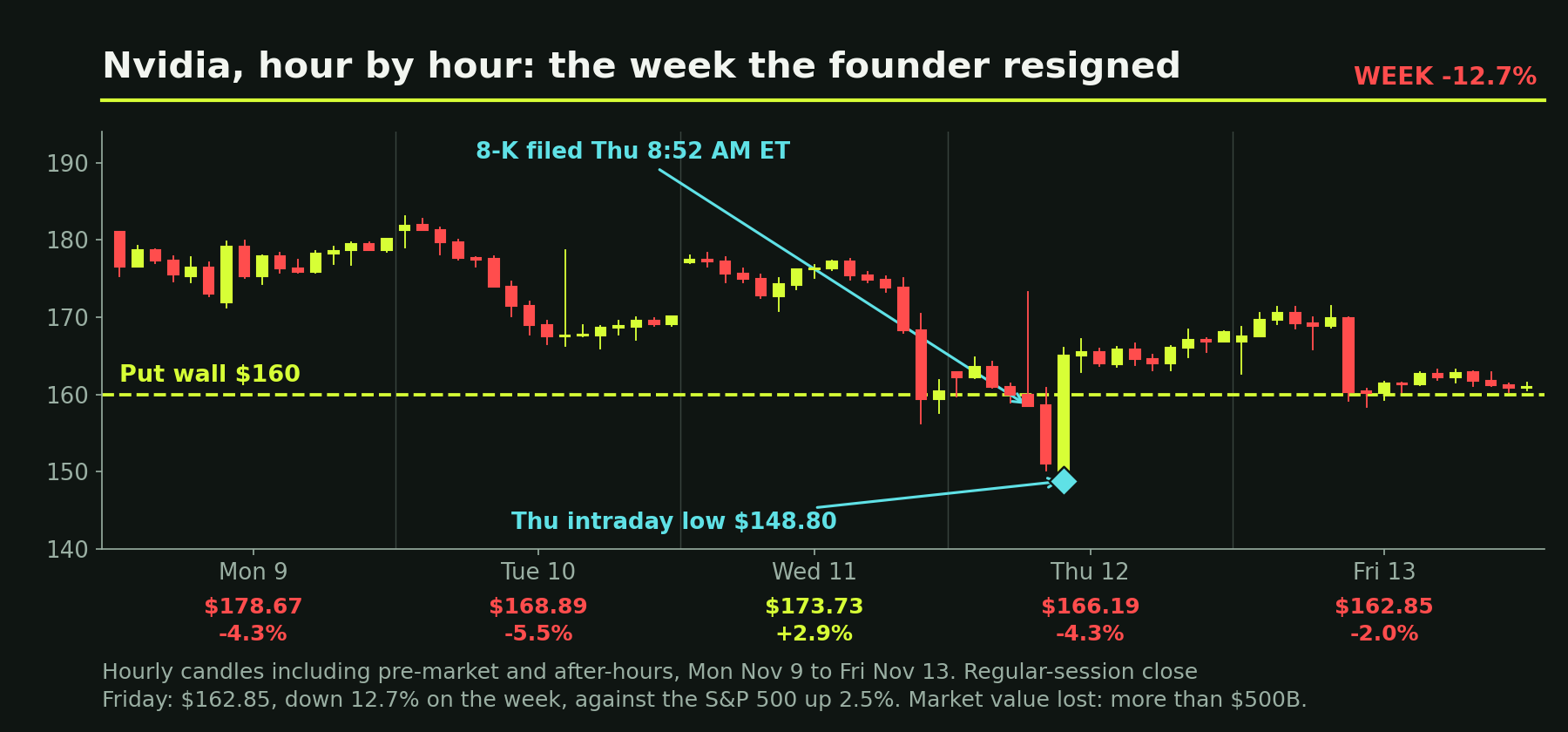
Nvidia hourly candles including extended hours, Nov 9 to 13. The resignation filing landed Thursday at 8:52 AM ET.
At 8:52 on Thursday morning, a filing a few paragraphs long ended a 33-year reign.
Jensen Huang, who co-founded Nvidia in 1993 and ran it ever since, was out as president, chief executive and board member, all at once, effective immediately. The filing gave no reason. It named a finance chief as interim boss and a board chair the company had never had before. Then the market opened, and Nvidia traded as low as $148.80.
Here is the strange part. The rest of the market had a great week. The S&P 500 rose 2.5%, its first winning week since early October and its best since August. AMD rose 19%. Broadcom rose 18%. CoreWeave, the data center landlord that had been the market's favorite worry, rose 14.5%. Nvidia fell 12.7%, and by our arithmetic gave up more than half a trillion dollars of market value in five days.
So the money didn't leave artificial intelligence this week. It left one company.
And the hard part hasn't started yet. On Tuesday, Nvidia reports earnings with an interim chief executive who is also its finance chief. On Wednesday, Huang is due at a closed-door briefing that three House committee chairs requested. That same day, Anthropic is expected to price its IPO, an offering of about $61 billion at the midpoint of its range, with trading set for Thursday. Six days that could reset the AI trade.
One rule runs through this whole issue, because this story will gather rumors faster than any this year. What a company files is fact. What news outlets report is reporting, and we label it every time. We'll keep the two apart.
The scoreboard comes first.
One Week, Two Shocks
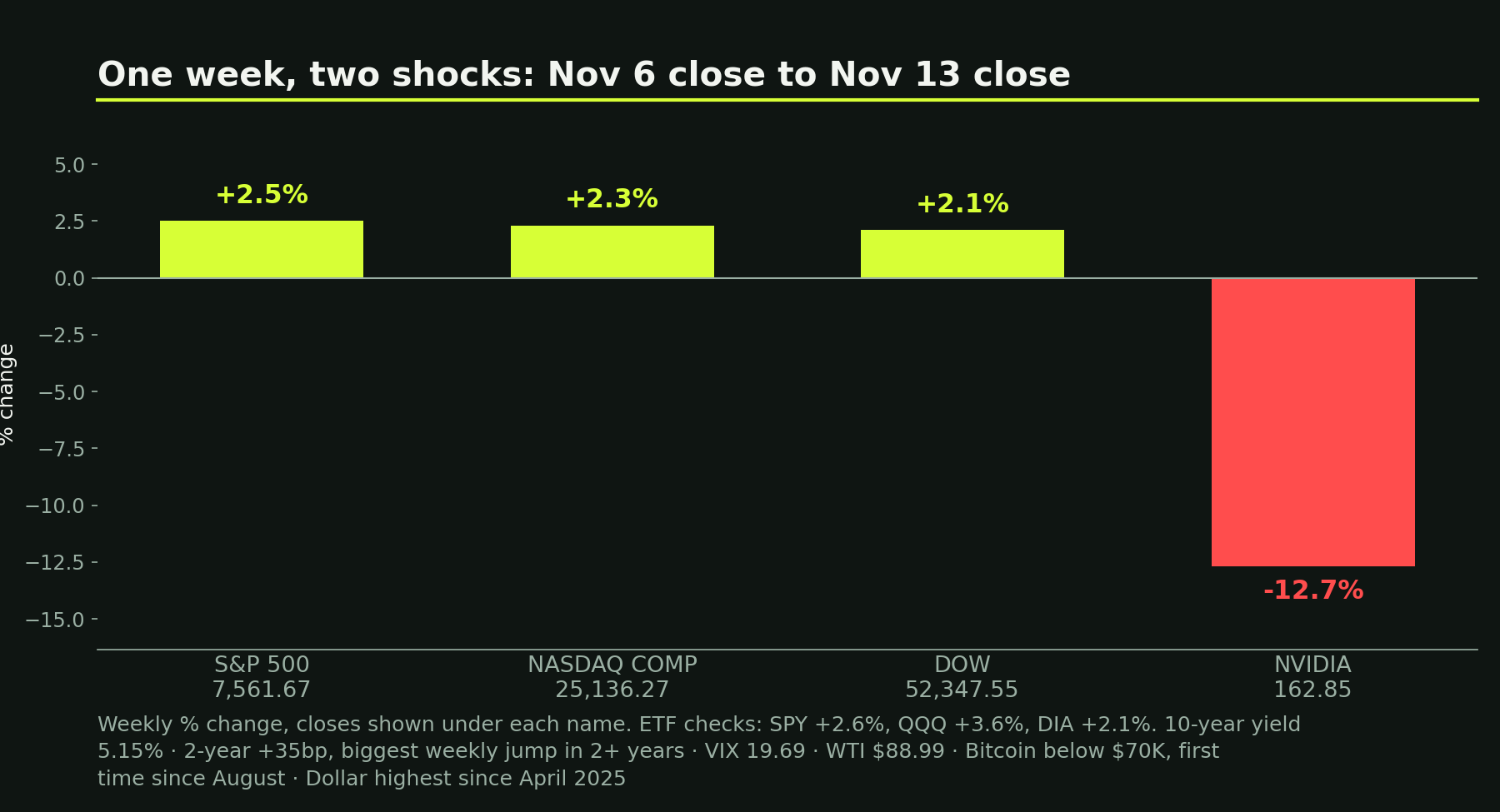
Weekly change, Nov 6 close to Nov 13 close.
S&P 500: 7,561.67. Up 2.5% on the week. (SPY: 754.21, up 2.6%.)
Nasdaq Composite: 25,136.27. Up 2.3%. (QQQ: 679.89, up 3.6%.)
Dow: 52,347.55. Up 2.1%. (DIA: 523.22, up 2.1%.)
10-year Treasury yield: 5.15%, up from 4.86% a week earlier.
2-year Treasury yield: up about 35 basis points, its biggest weekly jump in more than two years.
U.S. dollar index: its highest level since April 2025.
U.S. crude (WTI): $88.99 a barrel, down from $90.53.
VIX, Wall Street's fear gauge: just under 20, down from about 25.5 a week earlier.
Bitcoin: below $70,000 on Friday for the first time since August.
Read those lines again, because two of them don't belong together. Stocks had their best week since August. In the same five days, the 2-year yield, the market's best guess at where the Fed is going, had its biggest jump in more than two years. A jump like that usually weighs on stocks. This week it didn't, because the market was busy buying back last week's crash.
Translation: fear left the index and moved into one stock. The VIX fell. Nvidia's options traded like a referendum. The gap between those two facts is the story of the week.
Six Days That Ended an Era
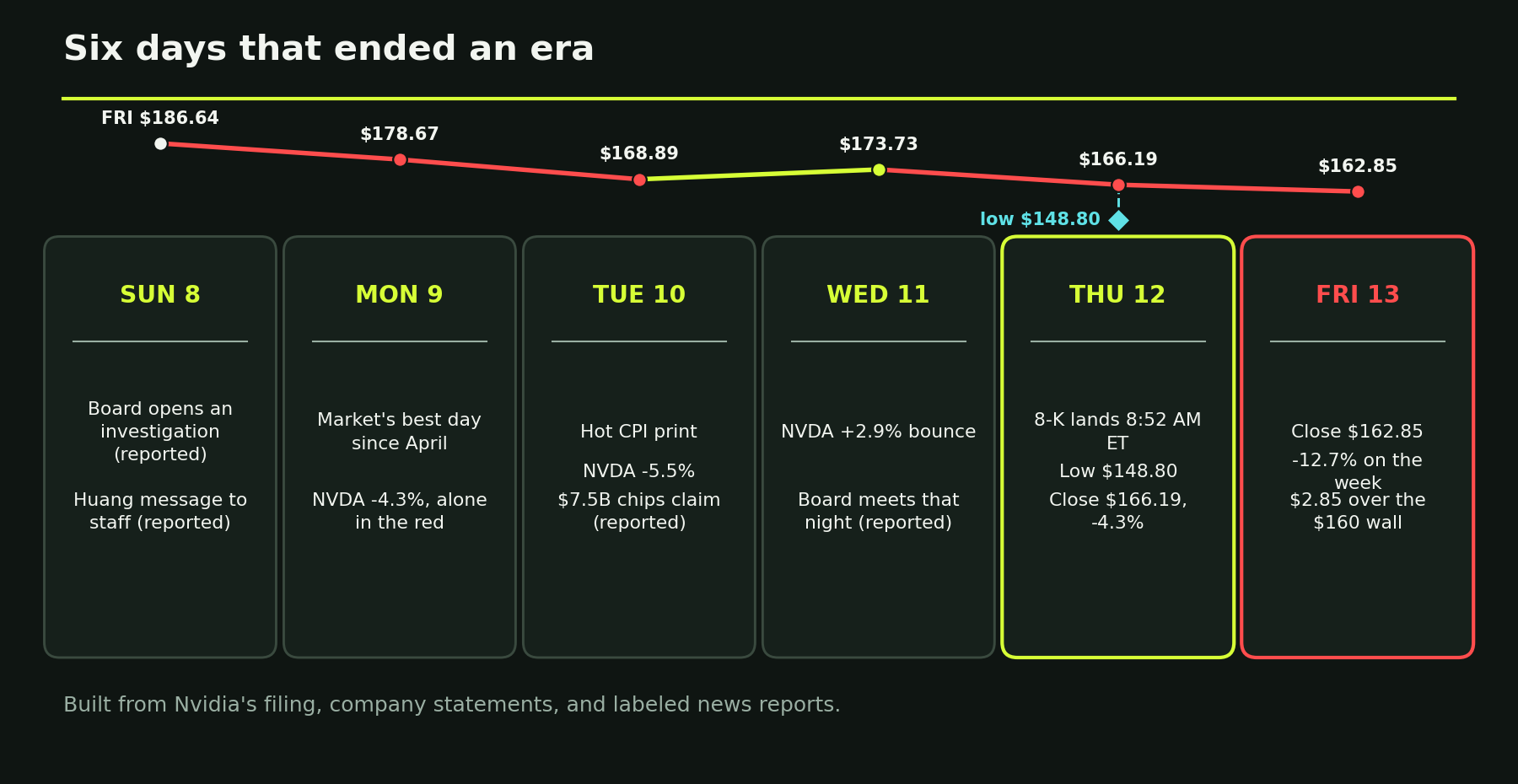
Timeline built from Nvidia's filing, company statements, and labeled news reports.
Sunday, November 8. Nvidia's board announced an independent investigation into whether Huang had been targeted by a foreign intelligence operation, while saying it kept its confidence in him. Huang acknowledged, in a message to employees, a relationship with Alice Huang (no relation), a former executive at Megaspeed, which Fortune describes as Nvidia's largest customer in Southeast Asia. U.S. officials reportedly assessed her as a Chinese intelligence asset. Those last two points are reporting, not findings.
Monday, November 9. The market staged its best day since April. The S&P 500 rose 2.35% and the Nasdaq Composite 2.74%. Nearly every name this desk follows went up. Nvidia fell 4.27% to $178.67, the only core name in the red. The same day, The New York Times reported that a Commerce Department investigation into suspected smuggling of Nvidia chips to China through Megaspeed was moved to the Justice Department after Nvidia's general counsel contacted the investigators. Megaspeed denies smuggling chips. Nvidia says it looked into the shipments in 2025 and found the claims false.
Tuesday, November 10. Consumer prices came in hot (more below). The S&P 500 slipped 0.38%. Nvidia fell another 5.53% to $168.80. The Information reported that the relationship helped move at least $7.5 billion of Nvidia chips to companies in China. That is a reported claim, not an established one.
Wednesday, November 11. Veterans Day: stocks open, bonds closed. The S&P 500 gained 1.31%, and Nvidia bounced 2.9% to $173.73. After the close, The Wall Street Journal reported that the board was meeting to discuss Huang's future, and the stock fell about 8% after hours. That night, the board accepted his resignation.
Thursday, November 12. At 8:52 AM ET, the filing hit the SEC's system. Nvidia traded as low as $148.80, then clawed back to close at $166.19, down 4.34%, on about 734 million shares, roughly double a normal day.
Friday, November 13. Nvidia closed at $162.85, down 2.01% on the day and 12.7% on the week. That's $2.85 above $160, the strike where the biggest pile of put options sits. More on why that matters in the gamma section.
Notice what the timeline shows. The market wasn't blindsided on Thursday. It had been pricing the risk all week, one headline at a time, while everything around Nvidia went up.
Filed vs. Reported
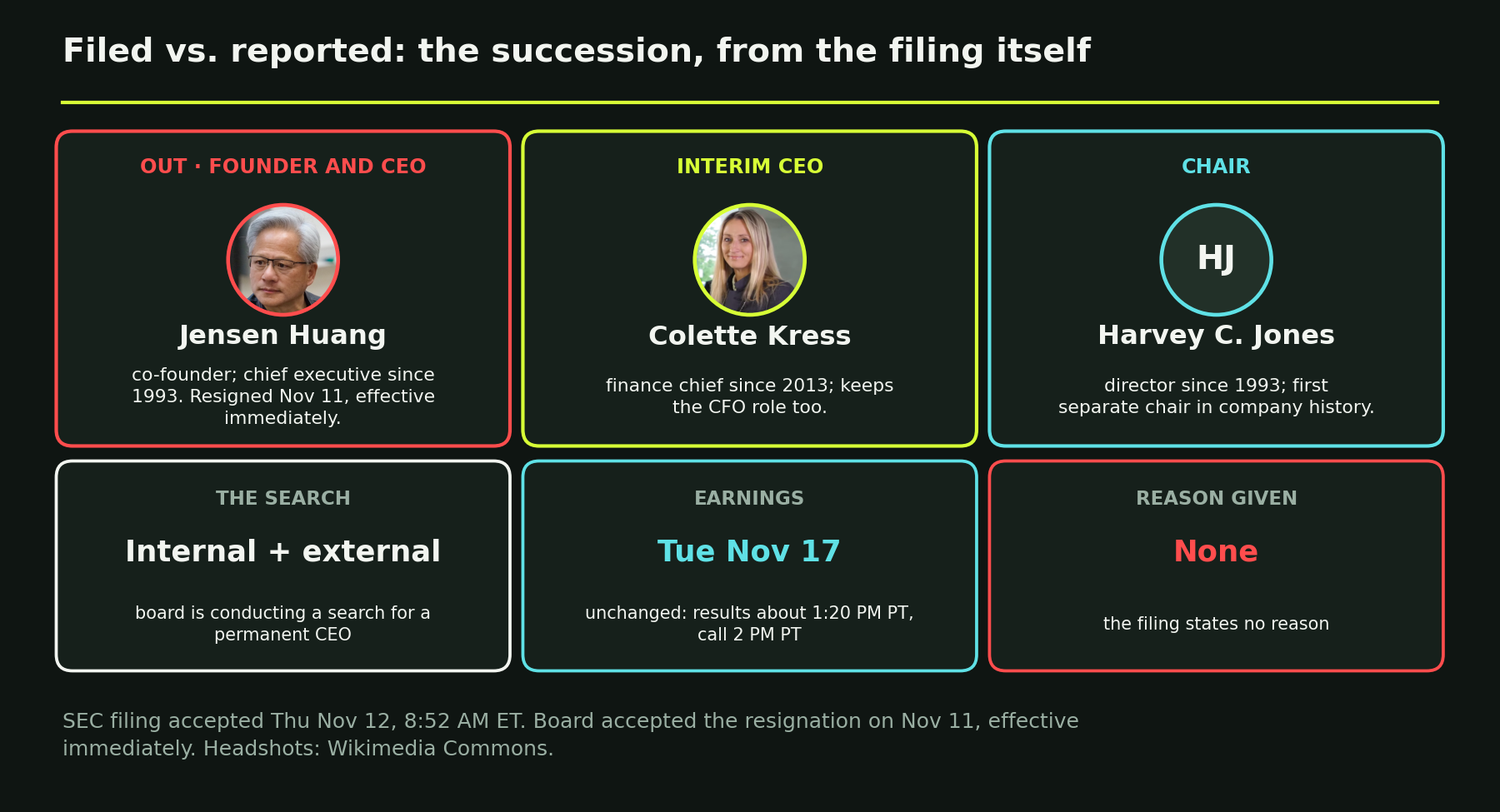
SEC filing accepted Thu Nov 12, 8:52 AM ET. The board accepted the resignation on Nov 11.
WHAT IS FILED. On November 11, the board accepted Jen-Hsun Huang's resignation as president, chief executive and director, effective immediately. It appointed Colette M. Kress, 59, as interim chief executive. Kress has been chief financial officer since 2013 and keeps that job too. It appointed Harvey C. Jones, 73, a director since 1993, as chair of the board, the first separate chair in Nvidia's history. The board is searching for a permanent chief executive and will look inside and outside the company. The filing gives no reason for the resignation and describes no severance. The earnings date did not move: Tuesday, November 17, at about 1:20 PM Pacific, with the call at 2 PM Pacific.
WHAT IS REPORTED. The relationship and the intelligence assessment. The Megaspeed investigation and its transfer to the Justice Department. The Information's $7.5 billion figure. The Journal's account of the board meeting. Reporting that Huang has agreed to answer questions from Congress. House committee chairs Brian Mast, John Moolenaar and Rick Crawford asked him to a closed-door briefing on November 18. None of this is in the filing, and none of it is a legal finding. It stays in this box until a filing, a court or an official statement moves it.
Now the most useful outside read of the week, from an unlikely source. Michael Burry, the investor famous for betting against housing before 2008, has spent the last year publicly betting against the AI boom and attacking Nvidia in particular. Here's how he read the choice of Kress on X: "The $NVDA Board would not have chosen Colette Kress during this crisis if it believed she were complicit." He also questioned why Nvidia hadn't promoted someone with broader experience running the business. He expects strong numbers on Tuesday and thinks the fallout will take longer to show. His advice to Nvidia bulls was blunt: "Get out." Weigh all of it knowing he has been short the trade.
Our read, separate from his: Kress is the continuity pick for a reason. For 13 years she has been the voice that delivered Nvidia's numbers to Wall Street. On Tuesday, the person who signs the numbers will also have to sell the story. Expect the market to grade two things at once: the quarter, and whether anyone besides Huang can tell investors what Nvidia builds next.
The Money Didn't Leave. It Moved.
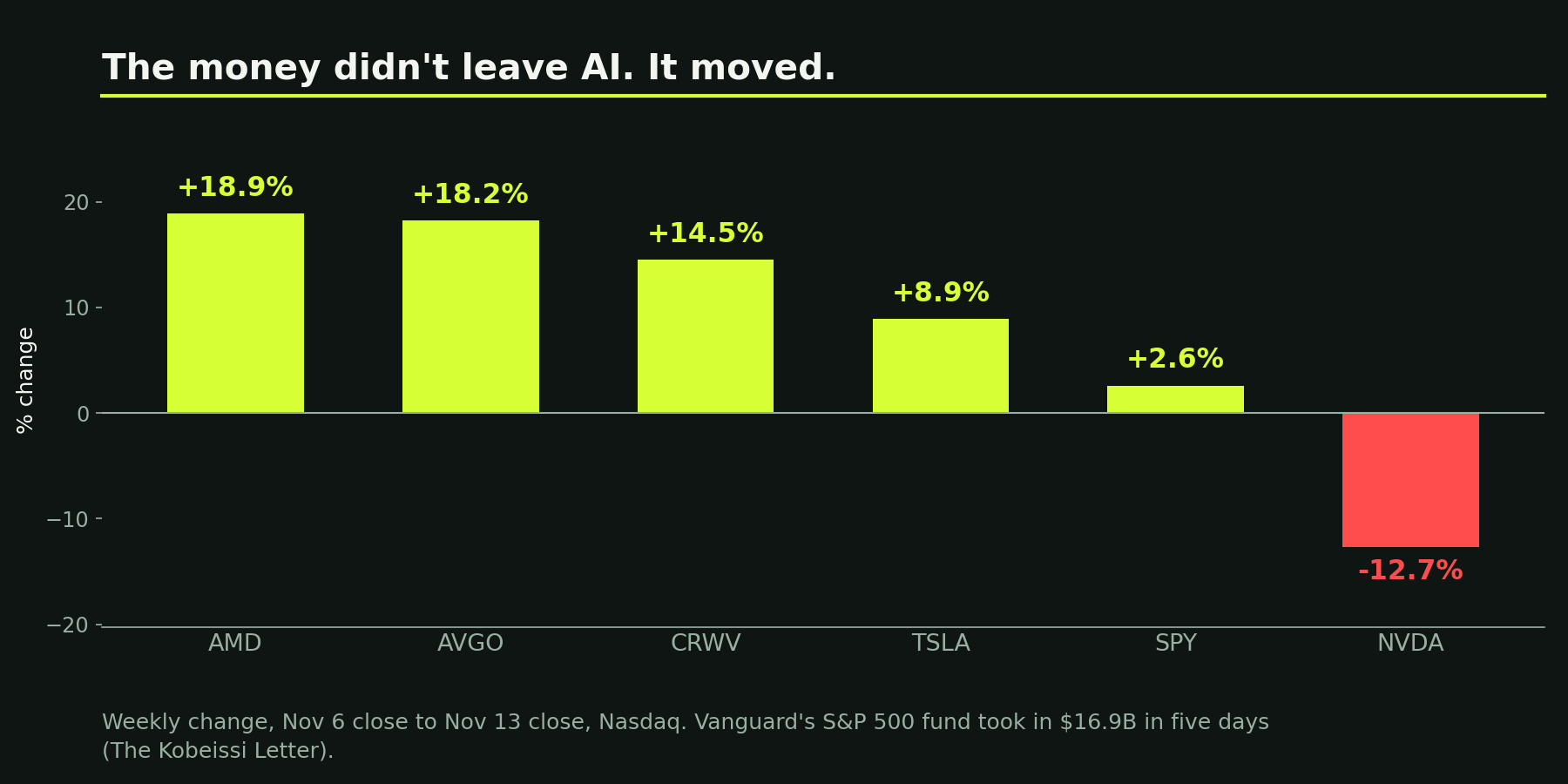
Weekly change, Nov 6 close to Nov 13 close.
If last week's crash had really been about AI demand dying, this week should have kept going down. It went the other way. On Monday, the Nasdaq 100 rose 3.3% and the Philadelphia Semiconductor Index jumped 6.6%, coming off its worst week since March 2025. AMD rose 13.3% that day and finished the week up 18.9% at $534.06. Broadcom rose 18.2% for the week. Investors poured $16.9 billion into the Vanguard S&P 500 fund in five trading days, according to The Kobeissi Letter.
Then came the strongest piece of evidence: CoreWeave's earnings. The company that rents out AI computing power reported third-quarter revenue up 168% to $3.66 billion. Its backlog of signed future business rose to about $132.5 billion, from about $104 billion three months earlier, and it raised its full-year revenue forecast to $13.0 billion to $13.3 billion. The stock jumped 24.7% on Wednesday.
Put it together and you get the week's insight. Last week the market sold the whole AI supply chain on politics and position-dumping. This week the demand data kept arriving, and the money came back to everyone except the one company with a crisis at the top. What got repriced wasn't AI. It was key-person risk: how much a company is worth without the person who built it.
The rally wasn't clean. AMD gave back 8.75% on Friday, a reminder that rebounds from a crash are fragile. But the scoreboard is clear: the AI trade got a stress test, and only one ticker failed it this week.
Nvidia wasn't the only trillion-dollar company to put a founder at the center of the week, though.
The Other Trillion-Dollar Story
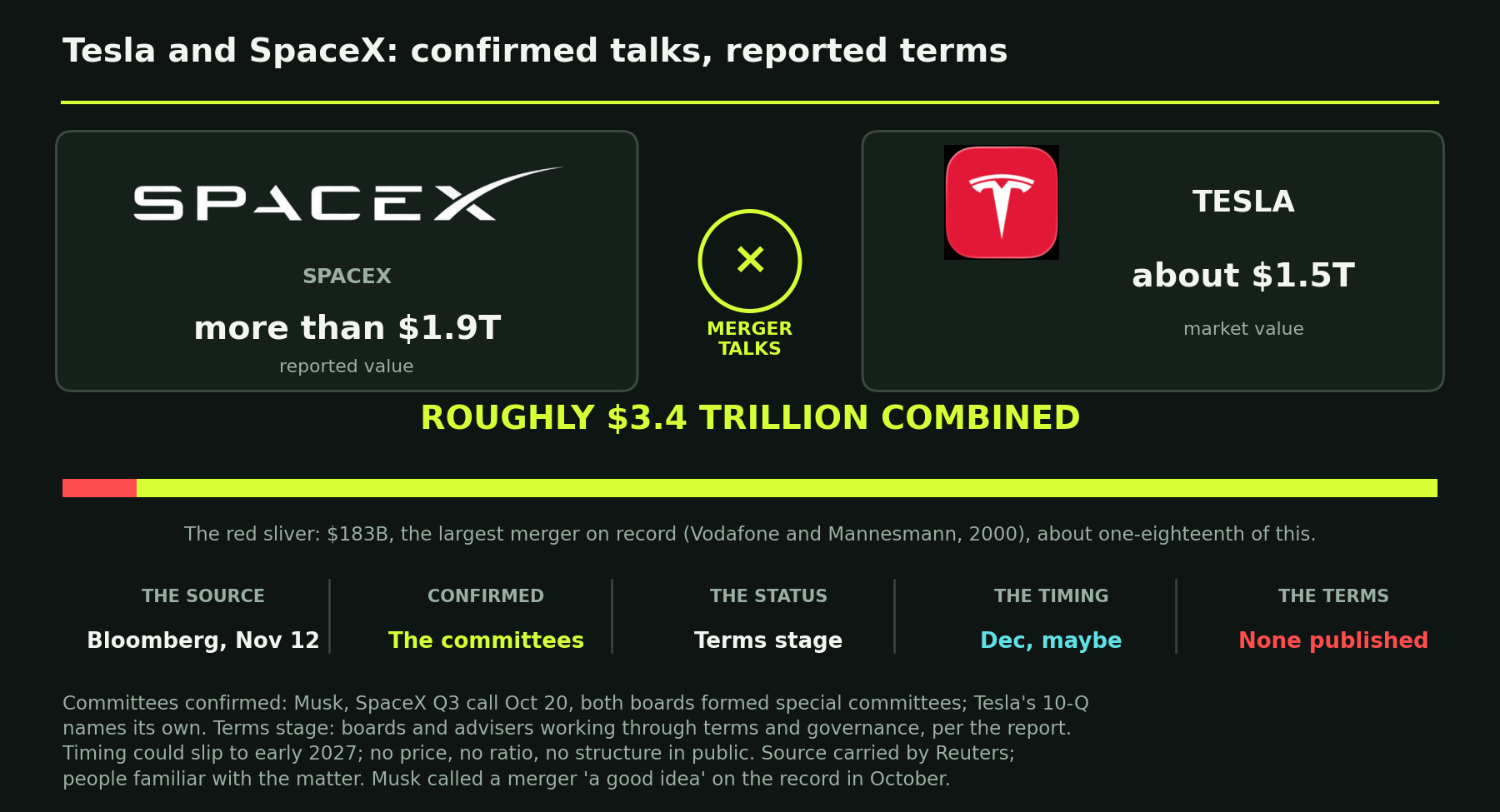
Musk confirmed the talks in October. Terms, timing and structure are still reported, not filed.
On Thursday, Bloomberg reported that SpaceX and Tesla are making progress in merger talks, and that a deal could be announced as soon as December, though it could slip into early 2027. This one starts from firmer ground than most merger rumors. Elon Musk said on SpaceX's third-quarter call in October that a merger would be "a good idea," and confirmed that both boards had formed special committees of independent directors to consider it.
What's still reporting: the timeline, and the claim that the boards and their advisers are now working through terms and governance, including how many SpaceX shares Tesla investors would receive. That detail matters. It describes SpaceX absorbing Tesla, not the other way around.
The size is hard to picture. SpaceX is worth more than $1.9 trillion and Tesla about $1.5 trillion, roughly $3.4 trillion combined. The biggest merger on record, Vodafone's $183 billion takeover of Mannesmann in 2000, would be about one-eighteenth of that.
The obstacles are real. According to Bloomberg, one of the hardest problems is walling off Tesla's big China business from SpaceX's U.S. government and defense work. Tesla's own filing says any deal needs its committee's recommendation and shareholder approval. Tesla's annual meeting is December 3, and a merger isn't on the ballot.
What a reader can do with this: hold the label, because talks at this stage still fail. Know that the deal will be decided by its terms, which nobody has published. And watch the right door: the next real development is a filing or a company statement, not another report.
For the record, Tesla rose 8.9% on the week to $390.22 and SpaceX rose 3.6% to $139.11, in a week when nearly everything rose. We don't claim the report caused either move.
The Prints: Rigetti and Hims
Rigetti (quantum computing) missed. Revenue was $1.41 million, down about 28% from a year earlier and far below the roughly $3.5 million analysts expected. The company blamed timing: revenue arrives when machines are delivered and customers sign off on them. The operating loss widened to $33.2 million from $20.5 million. Guidance, exactly as given: about $20 million of revenue for 2026, assuming India's Centre for Development of Advanced Computing (C-DAC) accepts its system and the revenue is recognized in the fourth quarter. With $10.9 million booked through September, that requires about $9.1 million in one quarter, more than six times what the third quarter produced. Most of that rides on one machine, a C-DAC order worth about $8.4 million. Rigetti also signed a research deal with the Commerce Department worth up to $100 million, and it has the cushion to wait: $497.1 million of cash and investments and no debt. The stock gave its own grade, and that's in Published Lines below.
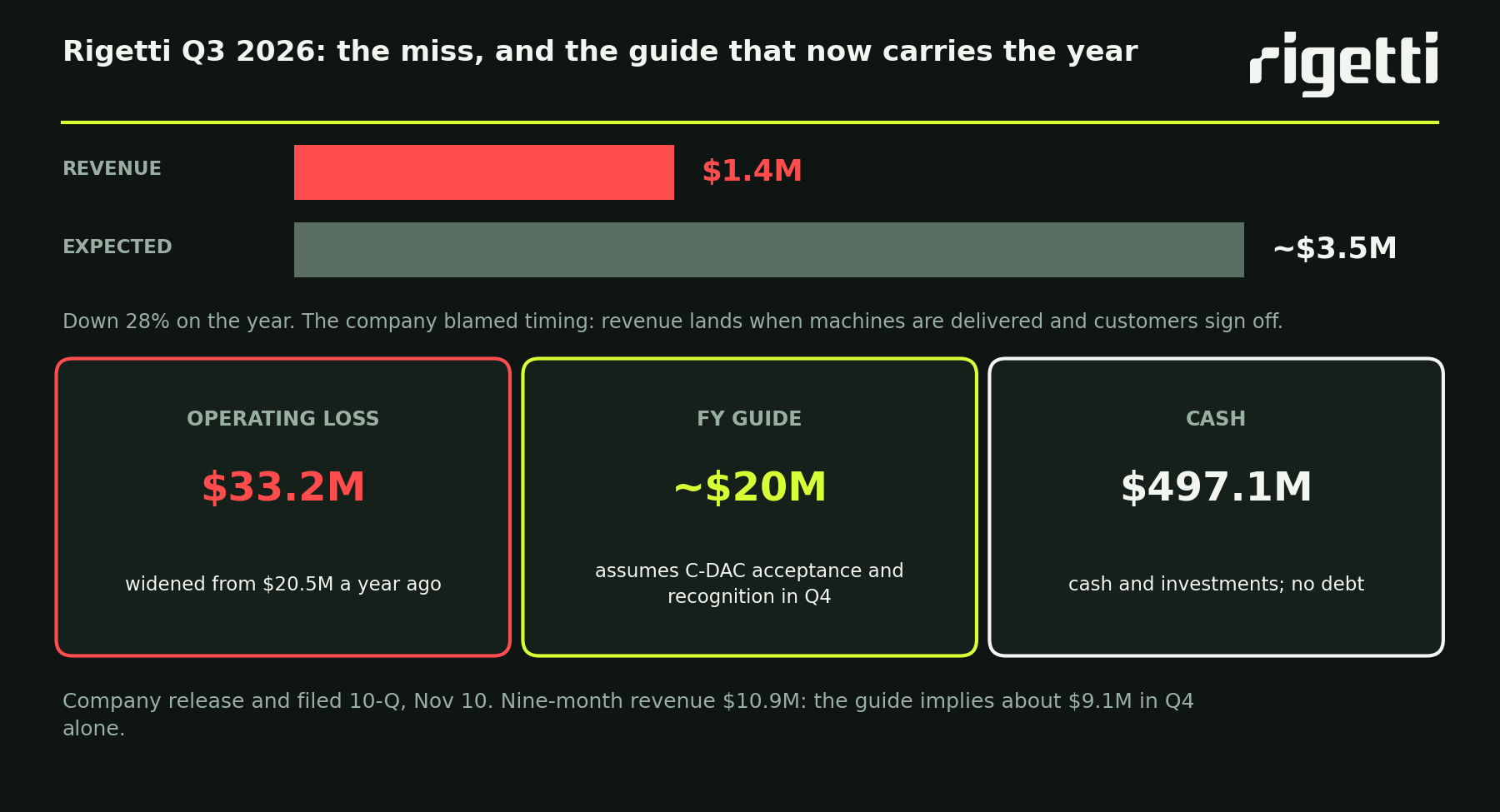
Rigetti Q3 2026, company release and 10-Q, Nov 10.
Hims & Hers (online health subscriptions) grew 49% and still lost. Revenue was $890.4 million, up 49% and just shy of estimates. But the company swung to a $33.0 million loss from a $15.8 million profit, and its gross margin, the share of each sales dollar left after direct costs, fell to 57% from 74%. That came from a shift toward lower-margin branded weight-loss drugs and a costly push overseas, where revenue more than quadrupled. Subscribers reached about 2.79 million, short of the roughly 3.04 million Wall Street expected. Guidance, exactly as given: full-year revenue tightened to $3.13 billion to $3.15 billion, adjusted EBITDA cut to $257 million to $277 million, and fourth-quarter revenue of $875 million to $895 million, below the roughly $955 million analysts had modeled. The stock fell 24.1% on the week to $19.73. The question in this print wasn't growth. It was what the growth costs.
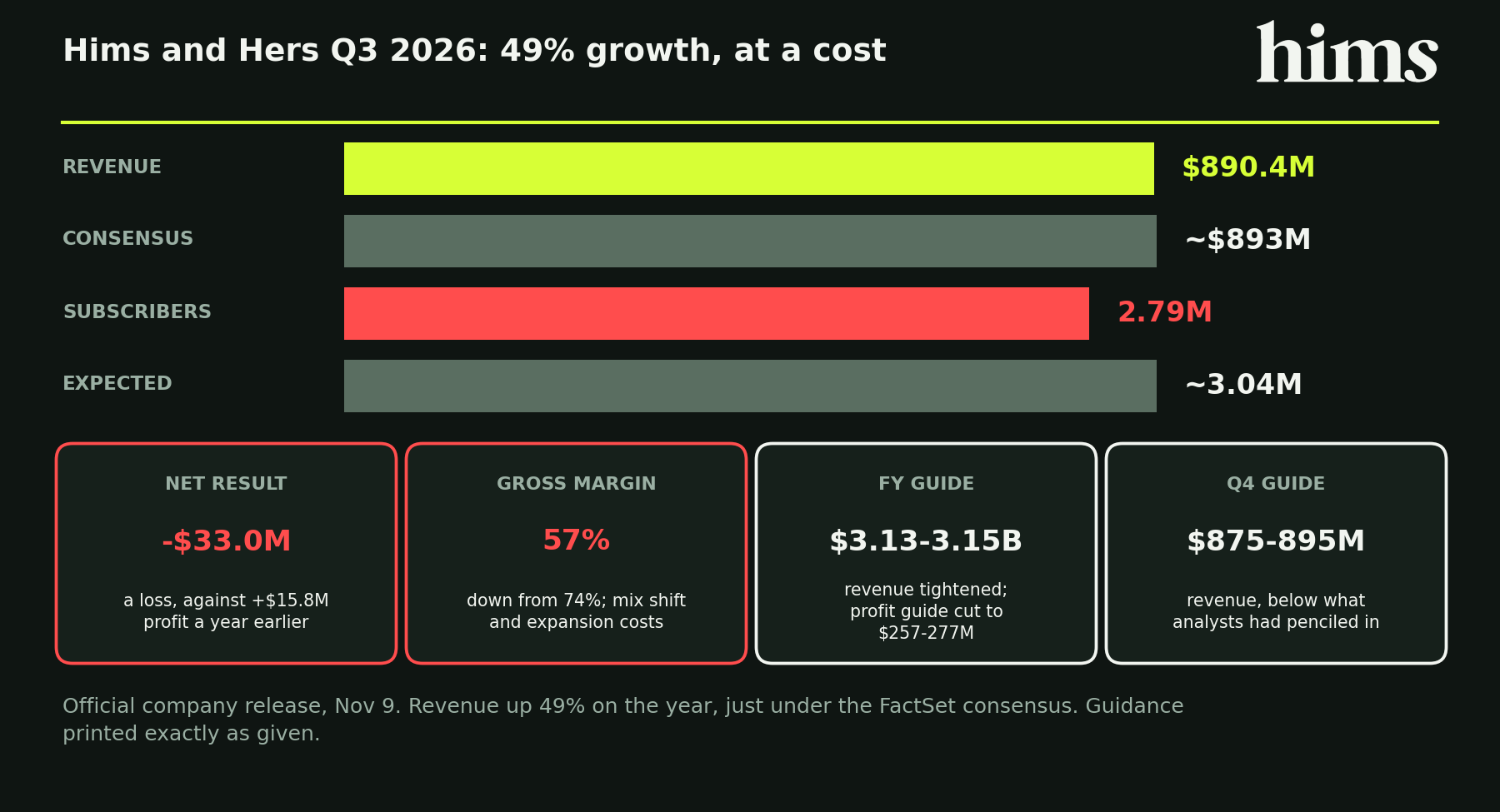
Hims & Hers Q3 2026, company release, Nov 9.
Inflation, Twice in One Week
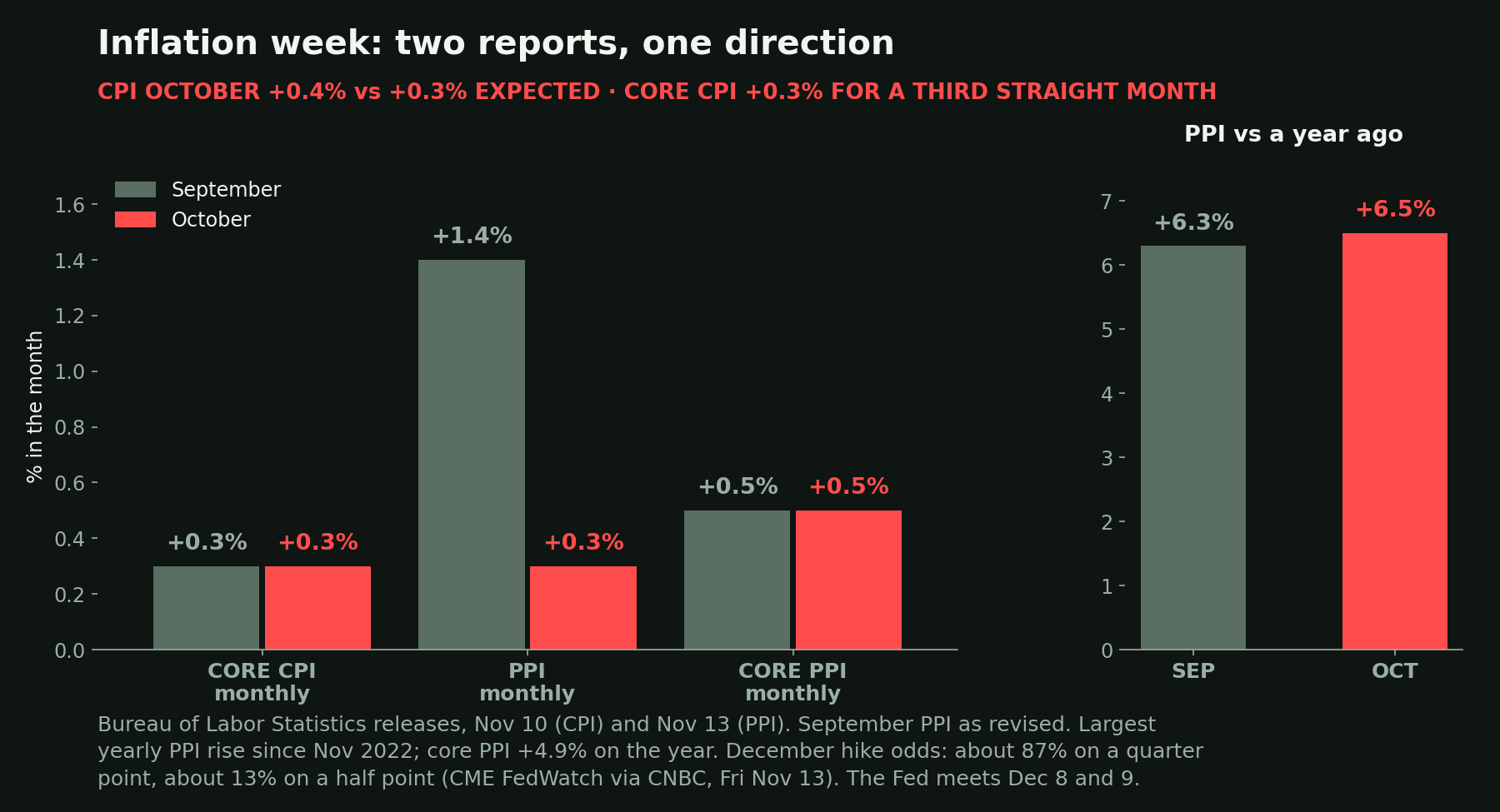
Bureau of Labor Statistics releases, Nov 10 (CPI) and Nov 13 (PPI).
Tuesday's consumer price index came in hot. Prices rose 0.4% in October against 0.3% expected. Core prices, which leave out food and energy because those swing so much, rose 0.3% for the third month in a row, against 0.2% expected. The report had no yearly inflation rate at all, for an odd reason: the government never collected October 2025 prices during last year's shutdown, so there was nothing to compare against.
Friday's producer price index, which tracks what businesses charge before goods reach store shelves, came in mixed. The monthly number was softer than feared: up 0.3% against the 0.4% economists polled by Reuters expected, after September's revised 1.4% jump. The yearly number was the warning. Producer prices are up 6.5% from a year earlier, the biggest annual rise since November 2022, up from 6.3% in September. Goods prices alone are up 10.2%, energy about 37%, and truck freight rates jumped 3.9% in the month. Core producer prices, without food, energy and trade services, rose 0.5% for a second straight month and 4.9% over the year.
Put the week together: consumer inflation ran hotter than expected, and wholesale inflation is running at its fastest annual pace in nearly four years. Friday's monthly relief means prices are climbing more slowly, not turning around.
The Fed noticed. Before Tuesday's report, Governor Christopher Waller said a hot core reading could lead him to back a half-point hike in December. By Friday, futures priced a December hike as close to certain: about 87% odds of a quarter-point move and about 13% odds of a half point. Wednesday's minutes from the October meeting will show how close that argument already was inside the room.
Rates, the Dollar, and the Price of Money
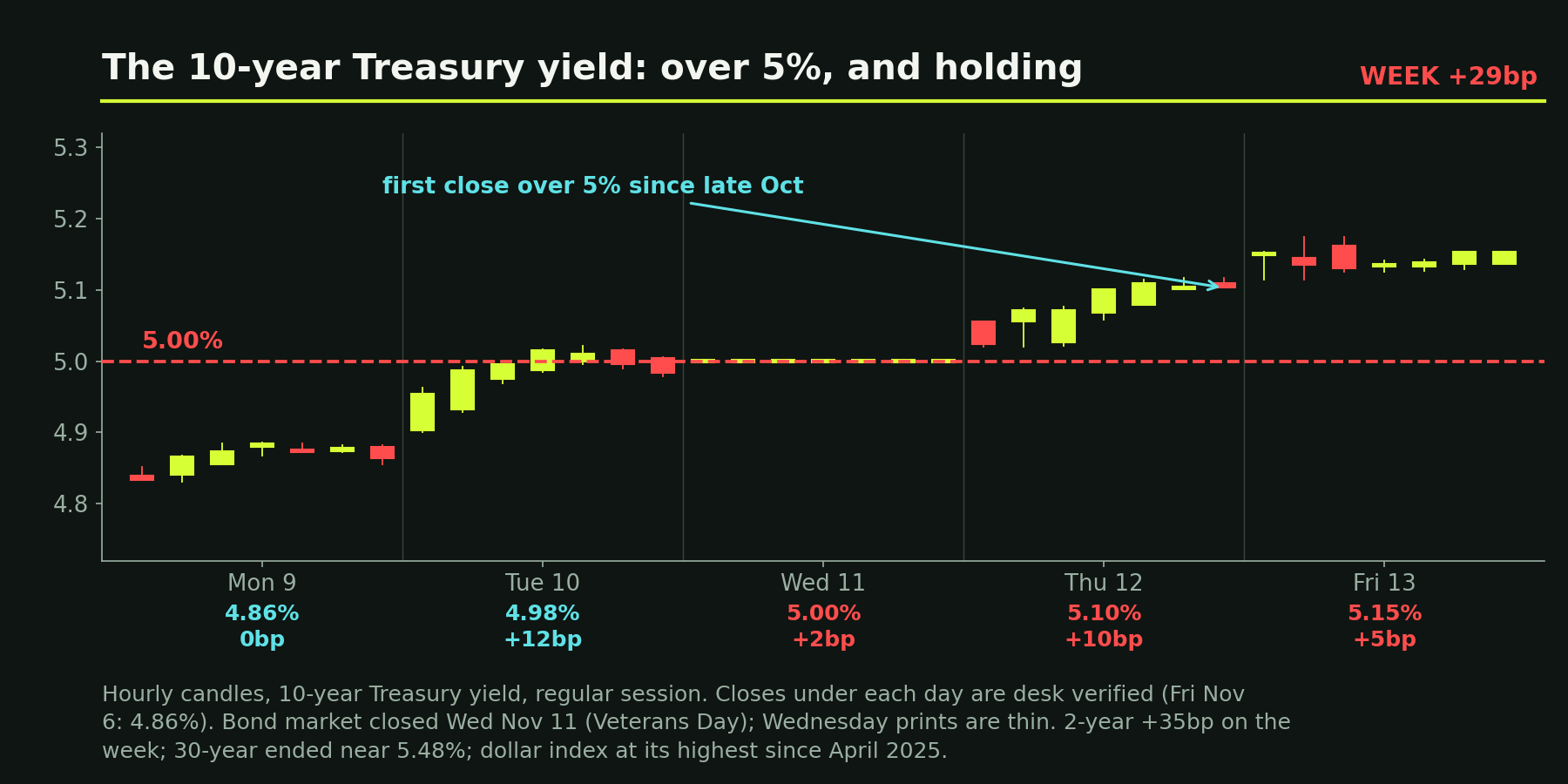
Desk verified closes. The yield closed above 5% on Thursday for the first time since late October and held there.
The bond market spent the week raising the price of money, and it didn't ask the stock market's permission.
The 10-year yield went from 4.86% last Friday to about 4.99% after Tuesday's report, briefly topping 5% that day. It closed above 5% on Thursday for the first time since late October, and ended Friday at 5.15%, about 30 basis points higher on the week. The 2-year jumped about 35 basis points, its biggest weekly rise in more than two years. The 30-year ended near 5.48%. The dollar index rose to its highest level since April 2025.
Everything that pays no interest lost that fight. Gold fell back below $4,000 an ounce. Bitcoin fell below $70,000 for the first time since August. And the same pressure hits the companies this letter covers every week: young businesses whose value rests on profits promised years from now. A 5% yield makes those distant profits worth less today. That's why a week of rising indexes still felt heavy for the speculative end of the market.
Oil, the story of earlier issues, mostly stepped aside. Brent settled at a two-month low of $91.49 on Tuesday after U.S. officials played down the need for more strikes on Iran. That's about 22% below the $117.64 close we reported two weeks ago. Monday's oil slide helped fuel the stock rally by easing inflation fears. But the strait isn't safe: 37 ships were attacked in and around Hormuz in October, the most since the war began, with 10 more so far in November. U.S. crude ended Friday at $88.99. The pressure this week came from bonds, not barrels. Oil can jump on one headline, but a 5% yield reprices every asset every day it holds.
One credit gauge from earlier issues. This desk watches CoreWeave's borrowing costs as its credit check on the smaller data center builders. No new verified bond reading came in this week, so the gauge stays where Issue #005 left it. The business answered half the question: revenue up 168% and a $132.5 billion backlog. The bond market still has to answer the other half.
So where did the big money position itself into all this? The options tape shows it.
What the Flow Said
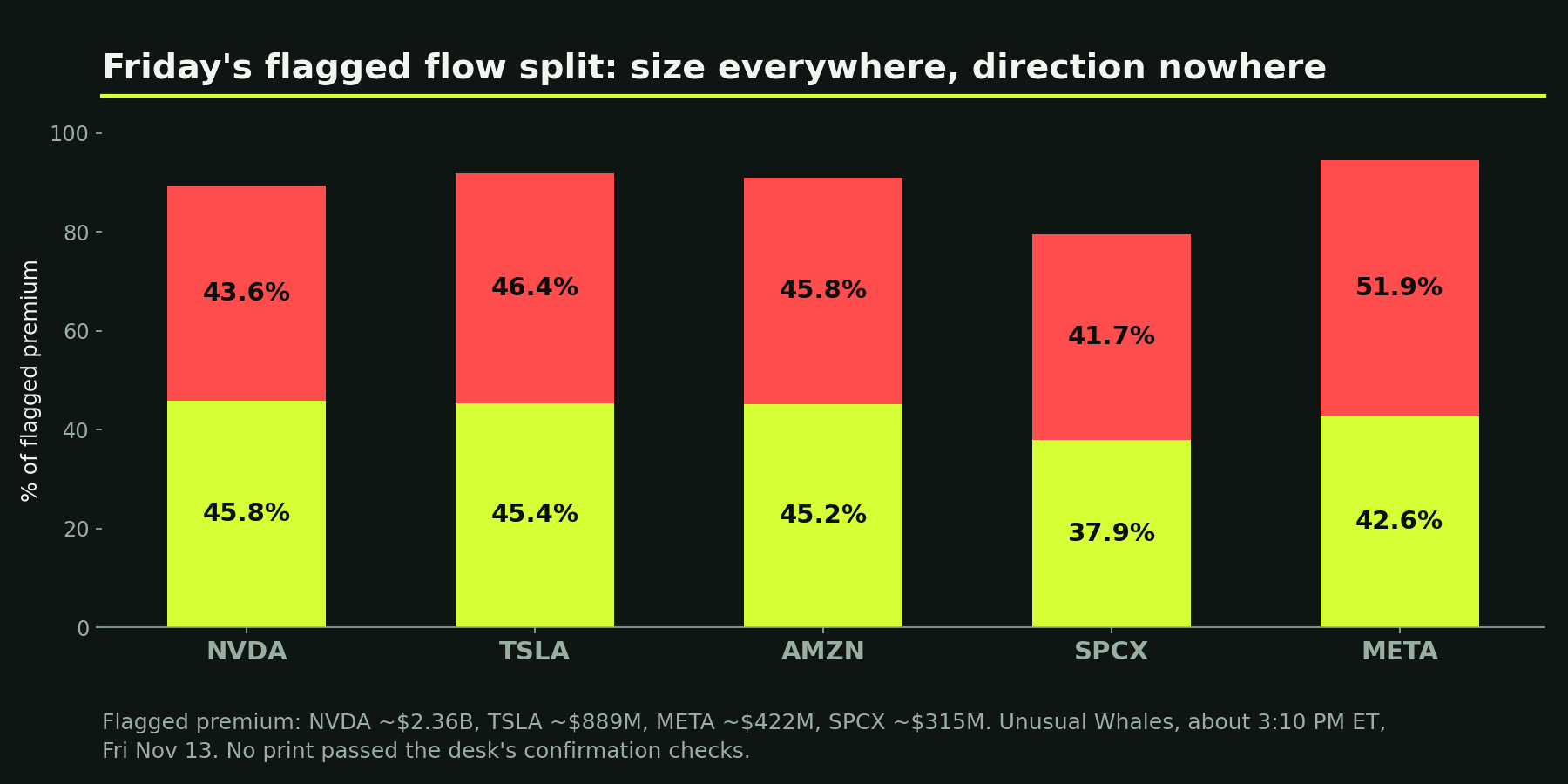
Unusual Whales flagged flow, Friday Nov 13, about 3:10 PM ET snapshot.
Friday's options tape showed lots of size and no direction, the same pattern as last week in a much bigger story.
Nvidia drew about $2.36 billion of flagged premium, almost perfectly balanced: about $1.08 billion bullish and about $1.03 billion bearish. The largest prints were multi-leg structures, the kind of trade that rearranges existing positions rather than betting on a direction.
Tesla drew about $889 million, balanced at about $404 million bullish and $412 million bearish.
Meta drew about $422 million leaning bearish, about $219 million against $180 million, on a day the stock rose 2.90%.
SpaceX drew about $315 million with a slight bearish lean. Alphabet and Amazon were balanced on smaller totals. IonQ's book stayed small, about $9 million, into a 6.48% drop.
And not one large single trade passed the desk's confirmation checks. On this desk, an unconfirmed print isn't a signal, however big it looks. Five days before the biggest earnings report of the season, with a new chief executive and a stock just above a major options level, money is positioned on both sides and committed to neither. That isn't a verdict. It's a market waiting for Tuesday.
The Gamma Picture
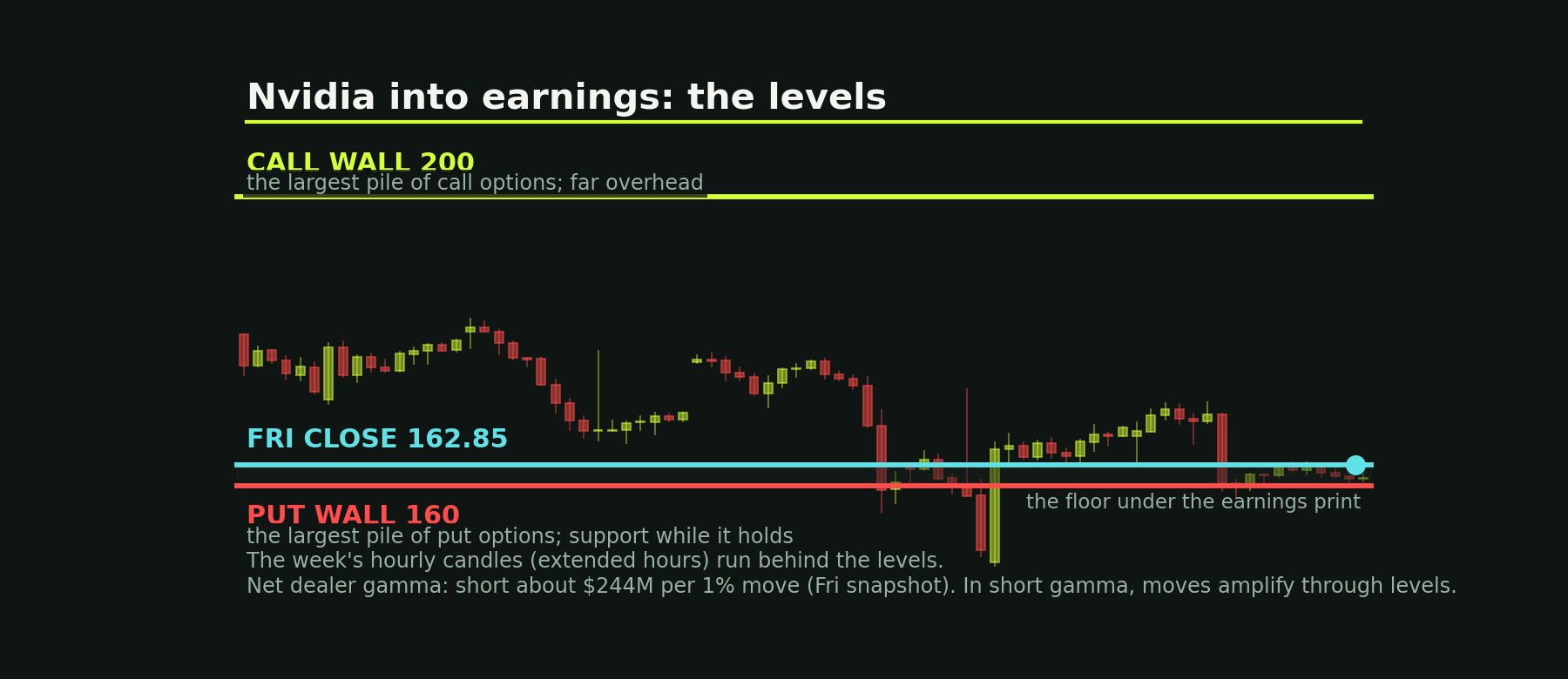
The levels that matter into Tuesday's print.
Gamma is this letter's home turf, so here's the short version. Market makers, the firms on the other side of most options trades, hedge by buying and selling the stock itself. Think of them as the market's shock absorbers. In positive gamma, their hedging leans against the move: they sell into rallies and buy into dips, so prices calm down. In negative gamma, the shock absorbers become amplifiers: they sell into drops and buy into rallies, so moves run through levels instead of stopping at them.
Friday closed in amplifier mode at the index level, and the desk's regime read printed RISK-OFF. Dealer gamma on the S&P 500 fund was short about $13.1 billion per 1% move at the close, and it got deeper through the session. The fund's put wall sits at 750 and its call wall at 775. Walls are the strikes where the largest piles of options sit. SPY closed at 754.21, just above its put wall, with the amplifier on.
Name by name, from the desk's afternoon snapshot:
Nvidia: call wall $200, put wall $160. Closed $162.85, just above the put wall, in a short-gamma book. Lose $160 into earnings and dealer hedging adds fuel to a drop. The $200 wall is far overhead.
Tesla: call wall and put wall both $390, flip at $400. Closed $390.22, right on the complex, in a large positive-gamma book, which is why it tends to pin there. A move through $400 changes its character.
SpaceX: both walls at $140. Closed $139.11, just under, in a small short-gamma book. $140 is the line the merger story will trade around until a company speaks.
Meta: put wall $640, call wall $700, flip $650. Closed $641.69, just above the put wall and below the flip, in the desk's largest positive-gamma book.
Alphabet: both walls $295, flip $350. Closed $295.77, just above, in a positive-gamma book. Holding $295 is the support read.
Amazon: both walls $265, flip $272.50. Closed $266.66, just above, in a large positive-gamma book.
IonQ: call wall $35, put wall $30. Closed $28.86, below both, with a near-flat book. Friday lost the $30 line it had reclaimed a week earlier.
These are levels to watch, never price targets.
The Published Lines: Friday's Closes
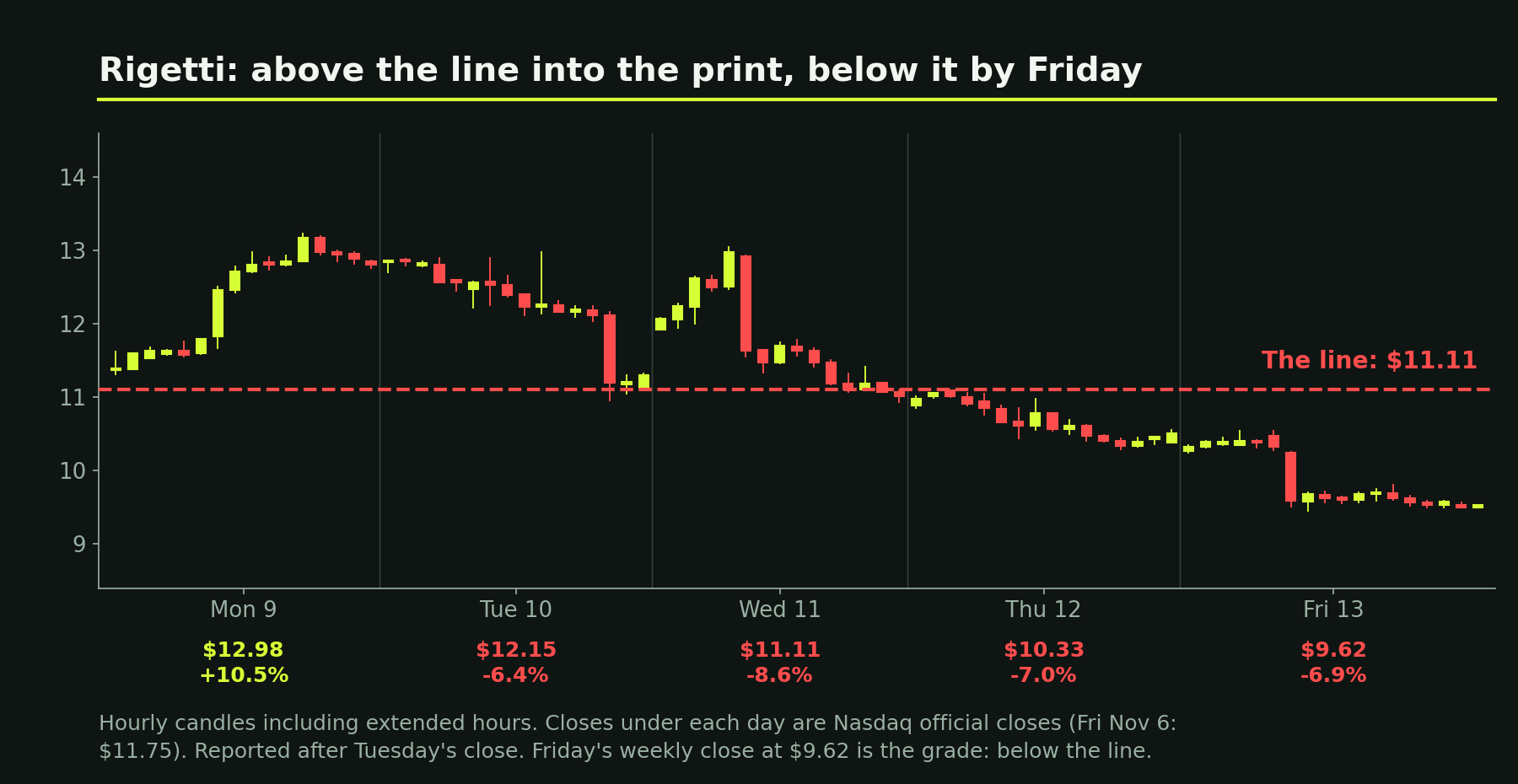
Nasdaq daily closes; the line is from the desk's published tracking of the name.
A line is only worth something if you report it the same way when it fails. This week, two failed. They come first.
Two words run this section. A staged entry means buying in planned pieces inside a zone. An invalidation is the line that proves the setup wrong.
Rigetti: the line is $11.11. The stock closed Tuesday, the day of its report, at $12.15. On Wednesday it closed at exactly $11.11. After the revenue miss sank in, it closed Friday at $9.62, below the line on the weekly close. That's a fail on the week's terms. The next test is the fourth-quarter delivery the company's guidance now depends on.
IonQ: the line was $30. A week ago the stock cleared it at $32.55. This week it fell every day but one and closed Friday at $28.86, back below. On the published terms, the name is under the line and under review. We print that the same way we'd print a hold.
Now the rest of the board.
AMD: published setup BUY, staged $440 to $466, invalidation on a weekly close below $413. Closed $534.06, above the zone, after touching $585.30 on Thursday and then dropping 8.75% Friday. The invalidation is far below and untouched.
Palantir: published setup BUY, staged $155 to $168, invalidation on a weekly close below $150. Closed $167.99, inside the zone and one cent under its top. Intact.
Cummins, the old line: the earlier research needed $497 to $516. Closed $452.11. Still not reached.
Cummins, the new line: WATCH, staged $429 to $456, invalidation on a weekly close below $428.74. Closed $452.11, its second straight weekly close inside the zone. A WATCH means the desk is watching the zone work, not that it has acted.
Apple: published setup BUY, staged $320 to $334, invalidation on a weekly close below $309. Closed $356.27, above the zone, which hasn't been tested on a close.
Alphabet: published setup BUY, staged $270 to $295, invalidation on a weekly close below $267.47. Closed $295.77, just above the zone, after pushing through $298.70 on Thursday. The invalidation is untouched, and the zone now sits just below the price.
Microsoft: published setup BUY, staged $500 to $520, invalidation on a weekly close below $480. Closed $523.88, just above the zone. It fell 1.3% in a week when QQQ rose 3.6%, the quiet laggard among the mega-caps.
Amazon: published setup BUY, staged $215 to $232, invalidation on a weekly close below $198.79. Closed $266.66, far above the zone.
All of the desk's deep dives are in the research library at zerogammaresearch.com/library, with the full work behind every zone and invalidation above.
Rapid Fire
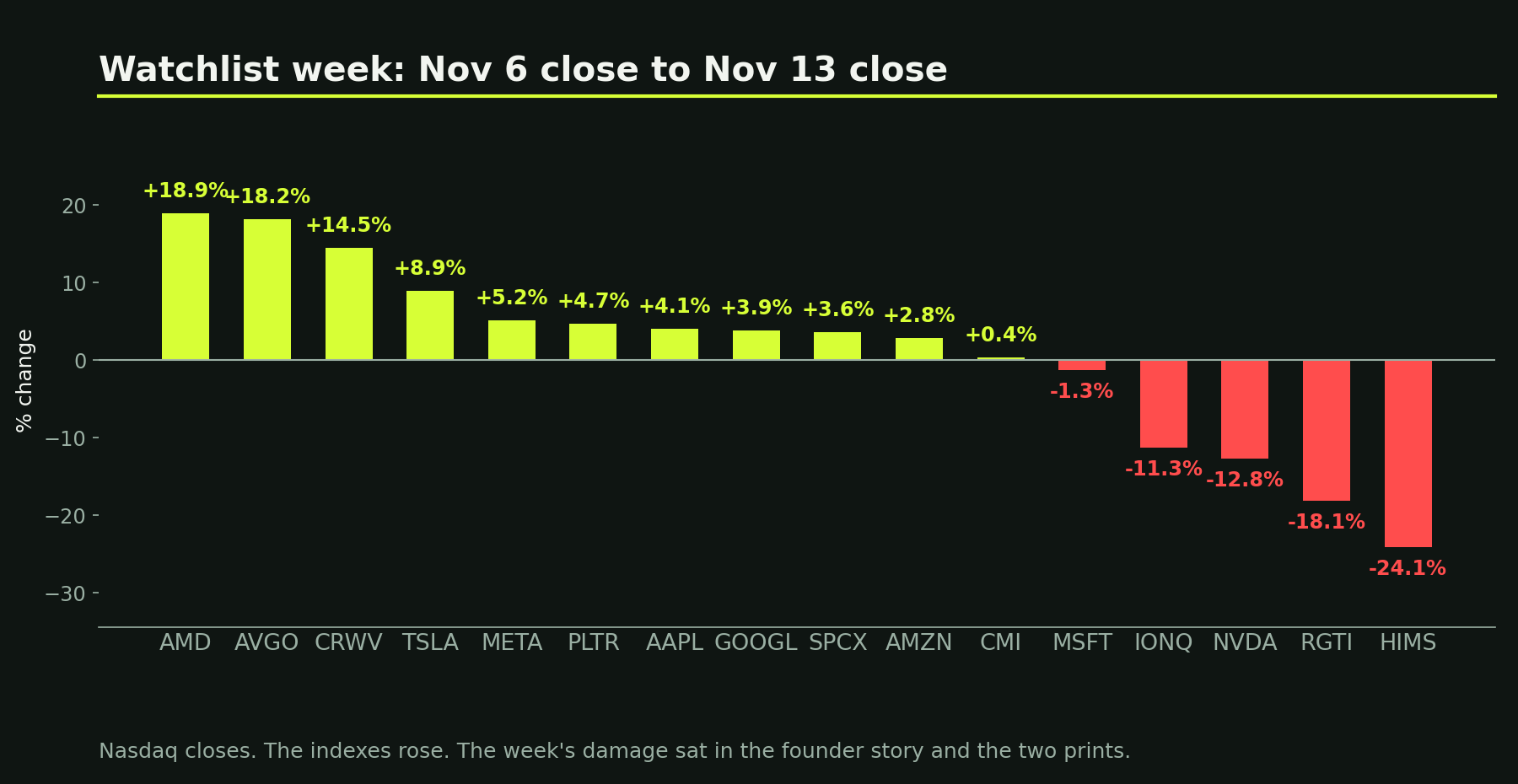
Weekly change, Nov 6 close to Nov 13 close, Nasdaq series, unless noted.
AMD rose 18.9% to $534.06, the watchlist's best week, even after Friday's 8.75% drop.
CoreWeave rose 14.5% to $53.13, most of it in a 24.7% jump the day after it reported a $132.5 billion backlog.
Tesla rose 8.9% to $390.22, right on its $390 gamma complex, with merger talks in the background and no terms.
Meta rose 5.2% to $641.69, leading the mega-caps on Friday with a 2.90% gain.
Palantir rose 4.7% to $167.99, a cent under the top of its published zone.
Apple rose 4.1% to $356.27 and Alphabet 3.9% to $295.77, both just above their published zones.
SpaceX rose 3.6% to $139.11, just under its $140 wall complex.
Amazon rose 2.8% to $266.66.
Cummins rose 0.4% to $452.11, a second straight weekly close inside its WATCH zone.
Microsoft fell 1.3% to $523.88, the only mega-cap in the red.
IonQ fell 11.3% to $28.86, losing the $30 line it cleared last week.
Nvidia fell 12.7% to $162.85, more than half a trillion dollars of market value, against an S&P 500 up 2.5%.
Rigetti fell 18.1% to $9.62 after its revenue miss.
Hims & Hers fell 24.1% to $19.73, the week's worst, as 49% growth came with a loss.
The 2-year Treasury yield rose about 35 basis points, its biggest weekly jump in more than two years.
Bitcoin broke below $70,000 for the first time since August.
Next Week: Six Days That Could Reset the AI Trade
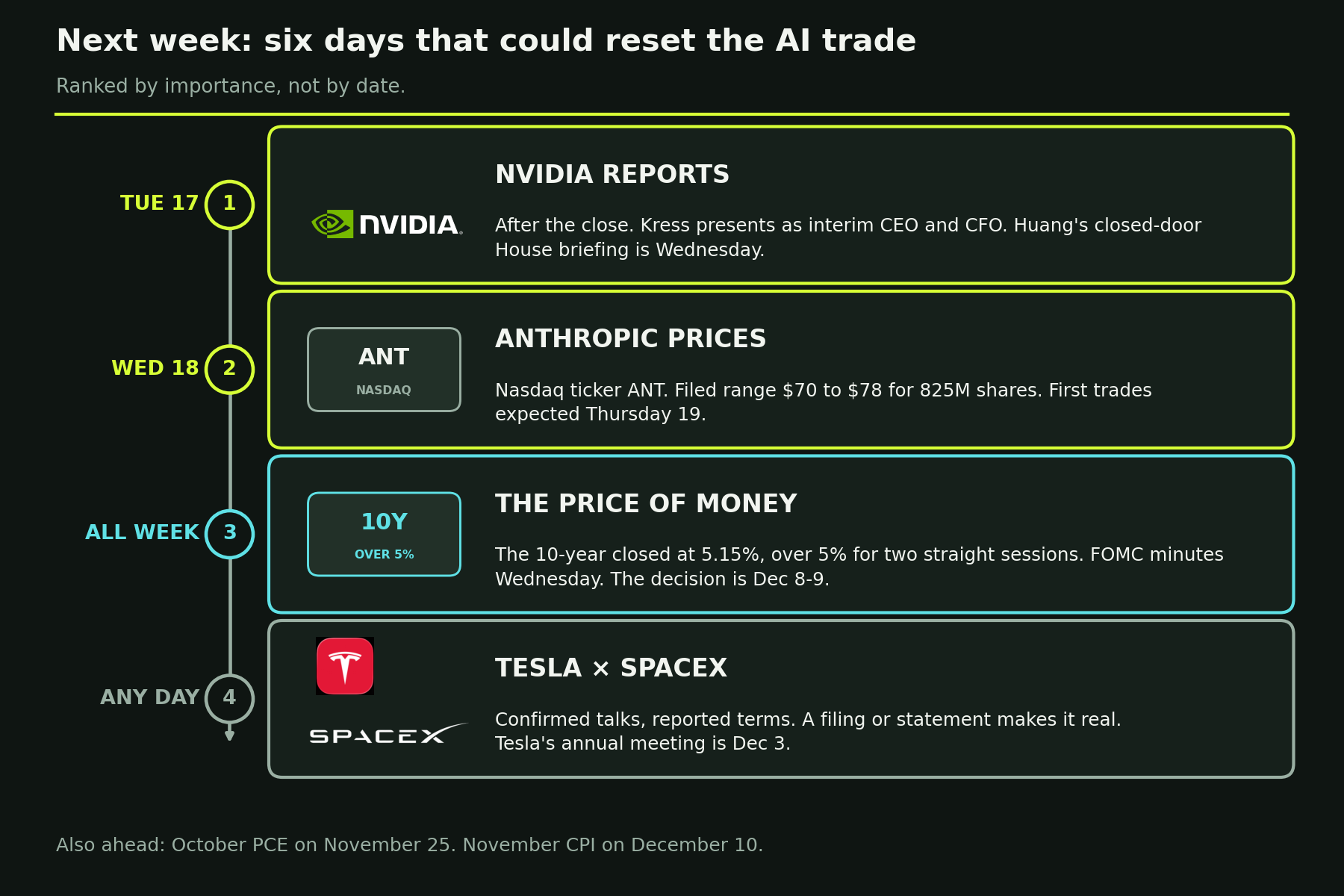
Ranked by importance and market impact, not by calendar order.
1. Nvidia earnings, Tuesday, November 17, after the close. The most important company in the AI trade reports five days after its co-founder resigned, with Colette Kress presenting as both chief executive and finance chief. Two things get graded. First, the numbers: the quarter and the guidance, exactly as Kress gives it. Second, the succession: any word on the search, the board's timeline, or why Huang left, if the company chooses to say. The stock goes in at $162.85, just above its $160 put wall, in a short-gamma book. A report that steadies the story and one that doesn't will both move fast from there. One day later, on Wednesday, Huang is due at the closed-door House briefing that committee chairs requested.
2. Anthropic's IPO, pricing expected Wednesday, November 18, trading Thursday, November 19. The maker of Claude has set a range of $70 to $78 a share for 825 million shares, to trade on Nasdaq as ANT. The offering alone is about $61 billion at the midpoint of the range, by our arithmetic, and it values the company near $1 trillion. The date and final price depend on regulatory clearance and demand, and the company hasn't confirmed a first trading day. Why it matters for everyone, not just buyers: it is the public market's first chance to put a price on a frontier AI lab, in the same week the AI trade's biggest name is in crisis. Strong demand says the money is still moving to AI. Weak demand says it isn't. Both outcomes will reach Nvidia's chart.
3. The price of money. The 10-year closed the week at 5.15%, above 5% for two straight sessions, and the dollar sits at its highest since April 2025. If the yield holds above 5%, every speculative name in this letter trades into a headwind. If it falls back below, that headwind eases. Wednesday's Fed minutes show how hawkish the October room already was. The decision itself is December 8 and 9, and a hike there is priced as close to certain.
4. A filing, or silence, from Tesla and SpaceX. The talks are confirmed and the terms are not. The next real step is a filing or a statement. Tesla's December 3 annual meeting is the next date on the calendar where a lot of investors will be listening.
How to Use This Issue
Three self-checks before anything in this letter touches your own portfolio: 1Separate the filed from the reported, in every story. Nvidia's leadership change is filed fact. The reasons around it are reporting. Tesla and SpaceX are confirmed talks with reported terms. Knowing which box a claim sits in is the whole skill this week, and it costs nothing to practice. 2Find your levels first. Every name in this issue carries a zone and an invalidation. Know yours, in writing, before you act on anyone's research, including ours. This week, two published lines failed exactly where they were drawn, and both failures are printed above in the same words as the passes. 3Check the calendar before the position. Nvidia reports Tuesday, its former chief executive is due before lawmakers Wednesday, Anthropic's IPO is expected to price the same day, and the 10-year sits above 5%. Know what lands, and when, before the week starts. Education only, always. The setups in this letter are the desk's research calls, published with their invalidation lines so you can grade us in public. They aren't personalized advice, and the decisions stay yours. |
WE’RE WATCHING
Nvidia on Tuesday. The quarter, the guidance, and any word on the search, from an interim chief executive who is also the finance chief. The stock goes in at $162.85.
Nvidia's $160 put wall. The stock closed $2.85 above it, in a short-gamma book. Holding it into the report keeps the floor intact. Losing it on a close turns the amplifier on.
Jensen Huang on Wednesday. The closed-door House briefing he is due at comes one day after earnings. Only an official statement or filing moves anything out of our "reported" box.
Anthropic's pricing. Expected Wednesday, with a range of $70 to $78. Where it prices inside, above or below that range is a live vote on AI valuations.
The 10-year above 5%. It closed at 5.15%. Holding there keeps the headwind on every speculative name. A drop back below would be the week's easiest relief.
The dollar at its highest since April 2025. A strong dollar tightens financial conditions worldwide and weighs on companies that earn abroad.
December hike pricing. Close to certain, with about 13% odds of a half point. Wednesday's minutes show the argument inside the room.
IonQ under $30. Closed $28.86. Reclaiming $30 repairs the story. Losing Friday's $28.25 low extends the slide.
Rigetti under $11.11. Closed $9.62. The full-year guide now rests on one customer signing off on one machine.
Tesla and SpaceX. Confirmed talks, unpublished terms. The first filing changes everything. Continued silence slowly prices it down.
| The desk’s posture: patient, with levels over narratives, in a RISK-OFF tape. This week the market rose while its most important company lost its co-founder in public, through a filing a few paragraphs long. The filed facts are few and clear. Everything else is reporting, pricing and levels. Until Tuesday's report lands, entries belong at levels, not at headlines. |
The Receipts
Here's where this week's numbers come from, so you can check us.
The succession: Nvidia's Form 8-K, Item 5.02, and its November 12 press release, read on the SEC's EDGAR system. The board acted November 11; the filing was accepted November 12. The earnings date and times come from that release.
The reporting around it: Fortune, The New York Times (as cited by multiple outlets), The Wall Street Journal (as cited by TechCrunch), The Information, Reuters and CNBC, each labeled as reporting in the text. Michael Burry's comments are from his posts on X and Substack, as quoted by Stocktwits and Yahoo Finance.
The merger item: Bloomberg News, November 12, as carried by Reuters, citing people familiar with the matter. Musk's October comments are from SpaceX's third-quarter earnings call.
Market closes: Nasdaq closing data, re-pulled after Friday's close; index closes and weekly changes match the Associated Press. Treasury yields: CNBC and Treasury data. Dollar index: Reuters and CNBC. Oil: Reuters; ship-attack counts from the Washington Institute for Near East Policy. The Vanguard fund inflow figure is from The Kobeissi Letter.
Inflation: Bureau of Labor Statistics releases for October CPI (November 10) and PPI (November 13). The PPI consensus is the Reuters poll. December rate odds: CME FedWatch, as reported by CNBC on November 13.
Earnings: company releases and SEC filings from CoreWeave, Rigetti and Hims & Hers. Guidance is printed exactly as each company gave it.
The IPO: Anthropic's amended S-1 of November 10 and its IPO site. The raise size is our arithmetic from the filed share count and range.
Flow, gamma levels and published lines: ZeroGamma desk data and the desk's published research.
Verify everything. That's the whole point.
|